

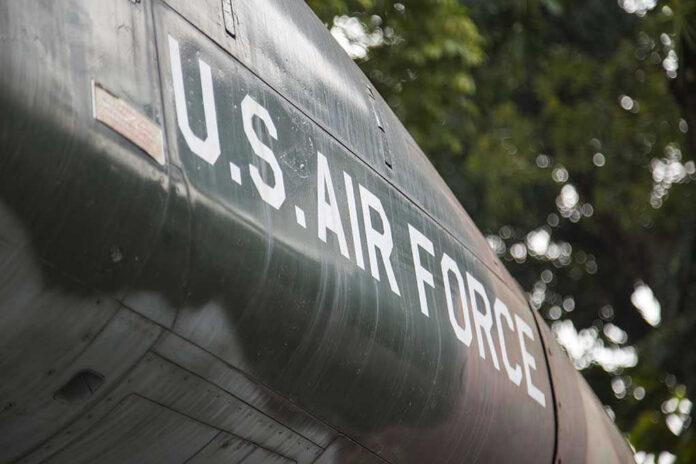
Eight Americans died in seconds when a B-52 Stratofortress fell out of the sky at Edwards Air Force Base — and nobody yet knows why.
Story Snapshot
- A B-52 Stratofortress crashed immediately after takeoff at Edwards Air Force Base in California on June 15, 2026, killing all eight people on board.
- The aircraft was on a routine test mission supporting the Air Force’s Radar Modernization Program when it went down and burst into flames.
- The crew was a mix of uniformed military, government civilians, and contractors — all eight are presumed dead.
- Officials confirmed the cause is unknown and launched a multi-stage investigation process that could take months to produce answers.
What Happened on the Runway at Edwards
The B-52 lifted off from Edwards Air Force Base and came right back down. Officials confirmed the bomber crashed “immediately after takeoff” and burst into flames on the runway. Emergency crews arrived fast and put out the fire. The crash stayed fully inside the base perimeter. But the aircraft was gone — and so were the eight people aboard. Investigators reviewed crash footage and quickly concluded the event was, in their words, “unrecoverable and unsurvivable.”[2]
Edwards Air Force Base sits about 100 miles north of Los Angeles. It is home to some of the most advanced flight testing in the world — the same desert where Chuck Yeager broke the sound barrier in 1947. Around 10,000 military personnel, contractors, and civilian employees work there. This was supposed to be a local test flight, executed according to a test plan. It was not a combat mission. It was not experimental in the dramatic sense. It was a scheduled sortie to support a radar upgrade program. That makes the sudden loss of the aircraft all the more jarring.[3]
Eight People, No Survivors, No Cause Yet
The eight people on board were not all uniformed military. Officials described the crew as a mix of active-duty service members, government civilians, and private contractors — the kind of mixed team common in test aviation.[1] All eight are believed dead. Officials did not immediately release names or specific roles. They also said they did not yet have the flight profile or crew details needed to begin building a causal picture. That information gap is not unusual this early. It is, however, deeply uncomfortable for families waiting for answers.
Colonel Hayes, speaking at the official press briefing, was direct about what the Air Force does not know. “At this point, we don’t have any indication as to what the cause was,” he said.[2] He then outlined a three-stage investigation process: first, an interim safety board; then a formal safety investigation board taking roughly 30 days; and finally, an accident investigation board to assign probable cause. That is the standard military aircraft accident pathway, and it is the right one. But it means the public will be waiting months, not days, for real answers.
Why the B-52 Still Flies — and Why That Matters Here
The Boeing B-52 Stratofortress first flew in 1952. The Air Force still operates it today, and plans to keep flying it into the 2050s. That longevity is a testament to the airframe’s design — but it also means the fleet carries decades of accumulated wear, upgrades, and modifications. The aircraft at Edwards was supporting a radar modernization effort, meaning it may have been carrying test equipment or operating in a non-standard configuration. Whether that played any role in the crash is entirely unknown at this point, but investigators will almost certainly examine it.[3]
Real tragedy. Wrong footage.
Eight dead after a B-52 crashed during a routine test mission at Edwards AFB. RIP.
Yet much of social media is already recycling footage from the 1994 Fairchild B-52 crash.
Different aircraft.
Different circumstances.
Different event.
Same…
— TheAsymmetricMind (@asymmetricmind) June 16, 2026
Past B-52 accidents offer a sobering reference point. A 2016 incident at Andersen Air Force Base in Guam ended with a B-52H departing the runway during an aborted takeoff. Investigators later found the cause was a combination of a pilot misreading cockpit cues, a drag chute failure, and brake system failure — a cascade of factors, not a single smoking gun.[17] The 1994 crash at Fairchild Air Force Base killed four crew members when a pilot flew the aircraft beyond its limits during a low-level maneuver. In both cases, the early public record looked much like this one: a crash, a fire, and no immediate answers.
What Investigators Will Need to Find
The Air Force controls the primary evidence in this case. That includes flight data, any recovered recorder outputs, maintenance logs for the specific airframe, tower communications, runway surveillance footage, and witness statements from ground crews and controllers. Officials said they would not release specifics quickly, and the formal investigation process gives them institutional cover to take their time.[2] That is not necessarily sinister — rushing a crash investigation produces bad findings. But it does mean the public will be largely dependent on what the Air Force chooses to release and when.
The families of the eight people who died deserve a full accounting. So does the broader American public, which funds and trusts this institution with its most advanced aircraft and its best people. The investigation process exists for exactly this reason. The question worth watching is not just what caused the crash — it is whether the findings, when they finally arrive, are complete, honest, and actionable enough to prevent the next one.
Sources:
[1] Web – 8 Killed in B-52 Crash as Second Military Aircraft Goes Down Within 24 …
[2] Web – Eight dead after U.S. Air Force B-52 crashes after takeoff at Edwards …
[3] YouTube – Officials give update on B-52 crash that’s believed to have killed 8 …
[17] Web – Eight presumably dead after US Air Force B-52 crashes … – Facebook
© horizonpost.com 2026. All rights reserved.