

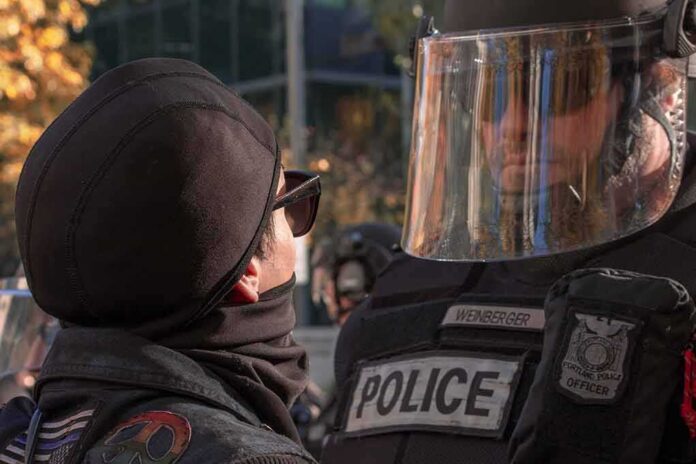
Twelve German police officers ended up injured after a peaceful rosary rally against abortion turned into a street clash with counterprotesters in Göttingen.
Quick Take
- Police say a pro-life rosary rally stayed peaceful until it ended, then counterprotesters tried to block the group’s exit.
- Officers formed a human chain and used pepper spray roughly 200 times to keep the two sides apart.
- Twelve police officers were hurt during the operation, according to multiple German outlets.
- Police opened several criminal investigations, including for assault on officers and violations of assembly law.
What Happened On The Göttingen Market Square
The rally, called a public rosary prayer against abortion, was legally registered with city officials. Police say the event went off without trouble for its entire scheduled run. Trouble started only when participants tried to leave the square in the early evening. A counterprotest had gathered nearby and, according to police, moved to block the group’s departure.
Officers formed a chain across the square to stop the two groups from making contact, police told reporters. When that barrier came under pressure, officers turned to pepper spray. Police say they used force or coercive measures more than 200 times during the operation, a scale that points to a serious, sustained confrontation rather than a brief scuffle.
Twelve Officers Hurt, Investigations Opened
Twelve police officers were injured during the clash, a number confirmed across several German news outlets covering the event. Ambulances were called to the scene to treat the wounded. Police described the injuries as a direct result of “Druck und Gewalt,” meaning pressure and violence, aimed at officers trying to hold the line between the two crowds.
Following the incident, police opened multiple investigations. Reports indicate at least seven separate criminal probes, covering alleged assault on law enforcement, bodily harm, insults, and a violation of assembly law tied to carrying pepper spray at a demonstration. Police leadership was blunt in its public statement, saying such conduct toward officers “have nothing to do with democratic forms of protest.”
A One-Sided Public Record, For Now
An advocacy account sympathetic to the pro-life group adds detail, claiming that only aggressive police intervention with barriers and irritants stopped counterprotesters from physically reaching rally attendees. That account lines up with the police version on the basic sequence: a peaceful rally, a hostile counterprotest at the exit, and officers caught in between. No independent video analysis or counterprotester statements have surfaced yet to challenge that account.
That gap matters. Right now, the public record leans almost entirely on police statements and a sympathetic advocacy outlet. No body-camera footage, medical logs, or counterprotester testimony has been made public. Common sense says a dozen injured officers and 200 uses of force don’t happen over a quiet disagreement, but a full accounting still requires the police’s own incident report and any charges that follow.
Why This Fits A Familiar Pattern
Germany’s constitution protects peaceful assembly for everyone, including groups whose views draw fierce opposition. That same legal framework gives police wide latitude to separate hostile crowds and use force when they judge a real danger is forming. Clashes like this one tend to repeat a pattern seen across Western democracies: a lawful, permitted gathering ends without incident, then flares up the moment organizers try to leave and a hostile crowd closes in.
The deeper question isn’t whether force was used. Both sides seem to agree it was. The real question is who forced the issue first, and whether the counterprotesters crossed from loud opposition into criminal conduct against a peaceful, permitted group and the officers protecting it. German prosecutors now have that job, and any charging decisions will tell the rest of the story.
Sources:
politischeverfolgung.de, tagesschau.de, idea.de
© horizonpost.com 2026. All rights reserved.