
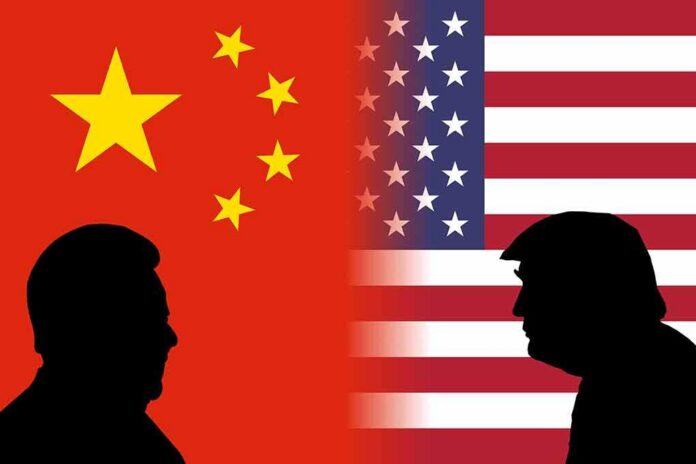
China barred an American reporter from the Trump–Xi–Putin session minutes after she shouted a sharp question at an earlier event, and it stood firm even when the White House pushed back.
Story Snapshot
- Bloomberg’s Annmarie Hordern was denied access after posing an unscripted question.
- Chinese officials told the press that shouting questions was “extremely rude” and grounds for removal.
- The White House sought her reinstatement; China refused, and the meeting proceeded.
- The dispute highlights a clash between press norms and host-country control of access.
What happened inside the tightly staged summit
Chinese officials blocked Bloomberg correspondent Annmarie Hordern from the opening remarks of the trilateral meeting with President Trump, China’s Xi Jinping, and Russia’s Vladimir Putin. The move followed a separate, earlier session where Hordern asked Trump, “President Trump, has Jensen Huang been disloyal to the United States?” Pool reports and multiple outlets tied the exclusion to that moment. A White House official tried to restore her access, but Chinese authorities declined.
Press guidance circulated to the traveling pool laid out a bright line. Chinese officials conveyed that yelling questions was considered extremely rude and that anyone who did so could be pulled from the room. Reporters described this as a rule communicated to the broader group, not a private warning after the fact. That put every journalist on notice that decorum, as defined by the host, would be enforced at the door.
Why the conduct rule matters for access
The sequence was direct. An unscripted question went out during a bilateral event. Soon after, the same reporter was blocked from the trilateral opening. The White House argued for access and still lost the point. The action signaled that the host would punish perceived disorder, even when it involved a United States reporter and drew a protest from United States officials present on site.
The question’s topic gave the moment extra heat. It touched on Jensen Huang and loyalty to the United States, linking diplomacy with national security and technology. That subject is sensitive in Beijing. The specific content did not appear in China’s stated rule; the stated rule focused on volume and timing, not topic. Still, to outside audiences, the optics read as control of message and room, not only etiquette.
How this collides with American press norms
White House press culture accepts structured turns but also expects reporters to try for news in brief room sprays. The White House Correspondents’ Association reminds members not to shout over colleagues, but it also recognizes that these scrums can be messy. The line is simple: secure order without using access as a weapon. That is why using exclusion as a sanction draws concern among journalists and many readers who value a free press.
American conservatives often see a clear principle here. Rules of the room should be clear, consistent, and not used to mute tough questions. A host nation can set decorum, but when it singles out a reporter after a question and denies re-entry over conduct many see as part of the job, it looks less like manners and more like message control. That reading aligns with common sense: let reporters do their work, then correct lapses without closing the door.
What Beijing enforced versus what Washington expects
China enforced a conduct rule that it said applied to everyone and backed it with the strongest tool it had: the credential check at the next entrance. Washington expects pushy but peaceful questioning as part of the deal when cameras roll. The clash showed who owned the room that day. China did, and it used that control to shape the sound and the sightline of a rare three-leader tableau.
𝐁𝐋𝐎𝐎𝐌𝐁𝐄𝐑𝐆 𝐑𝐄𝐏𝐎𝐑𝐓𝐄𝐑 𝐅𝐀𝐂𝐄𝐒 𝐁𝐀𝐍 𝐅𝐑𝐎𝐌 𝐓𝐑𝐈𝐋𝐀𝐓𝐄𝐑𝐀𝐋 𝐒𝐔𝐌𝐌𝐈𝐓 — 𝐀𝐒𝐊𝐄𝐃 𝐈𝐅 𝐍𝐕𝐈𝐃𝐈𝐀'𝐒 𝐂𝐄𝐎 𝐖𝐀𝐒 𝐃𝐈𝐒𝐋𝐎𝐘𝐀𝐋 𝐓𝐎 𝐓𝐇𝐄 𝐔.𝐒.
A Bloomberg reporter embedded in the White House travel pool is now at risk of being locked out of… pic.twitter.com/2piaa2R14t
— M.A. Rothman (@MichaelARothman) November 19, 2026
The episode will echo beyond one spray. Foreign correspondents in China often face tight limits, and small acts can draw stiff responses. That pattern explains why a single shouted question turned into a hard stop at the next door. The lesson for future summits is blunt: if the host signals a zero-tolerance rule, any reporter who tests it may lose the next seat, even when the United States government objects.
Sources:
thewrap.com, bostonglobe.com, wrbl.com, thedailybeast.com, whca.press
© horizonpost.com 2026. All rights reserved.