
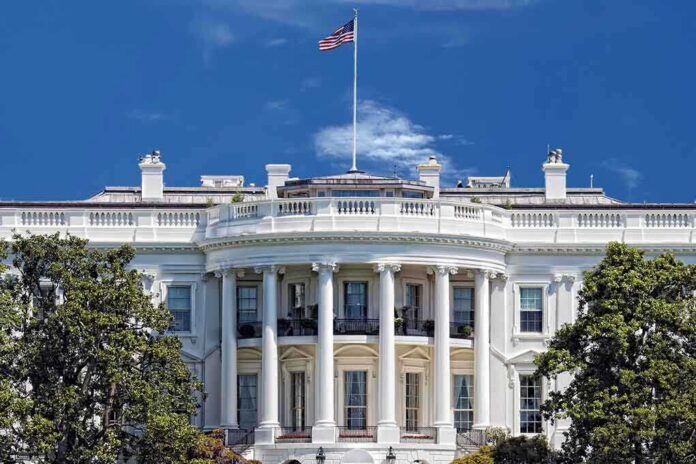
A suicidal man’s 300-mile journey from Indiana to the gates of America’s most protected residence ended in a hail of Secret Service gunfire just after midnight, exposing how mental health crises increasingly collide with high-security perimeters.
Story Snapshot
- Secret Service agents shot an armed man near the White House after Indiana police warned he was suicidal and traveling to Washington, D.C.
- The confrontation erupted when the man brandished a handgun as agents approached him on foot near 17th and F Streets NW, one block from the White House
- President Trump was at Mar-a-Lago during the incident, with no injuries to Secret Service personnel or disruption to his scheduled return
- D.C. Metropolitan Police are leading the use-of-force investigation, with the suspect’s identity and condition still unknown
When Cross-State Intelligence Meets Crisis Intervention
Indiana law enforcement alerted federal authorities Saturday about a potentially suicidal individual headed toward the nation’s capital. The Secret Service located the man’s parked vehicle near the Eisenhower Executive Office Building and spotted someone matching his description on foot. When agents approached just after midnight Sunday, the man brandished a handgun. An armed confrontation ensued, during which Secret Service personnel fired shots. The man was immediately transported to a local hospital, though authorities have not disclosed his condition or identity.
This incident underscores the critical importance of inter-agency communication in protecting high-value sites. The Secret Service’s ability to preemptively locate the suspect’s vehicle demonstrates how real-time intelligence sharing between state and federal agencies can prevent potentially catastrophic outcomes. The fact that agents were already positioned and aware before the confrontation suggests the system worked exactly as designed, even if the outcome required lethal force.
The High-Security Zone Where Personal Crisis Meets Federal Authority
The shooting occurred at 17th and F Streets NW, in the heart of Washington’s most heavily guarded district. This location sits adjacent to the West Wing complex, where routine tourist traffic mingles with federal employees and Secret Service checkpoints define every corner. The overnight timing meant minimal civilian presence, yet the zone remains perpetually monitored by multiple security layers including cameras, patrols, and armed personnel trained for exactly this scenario.
Secret Service protocols for armed threats leave little room for hesitation. When an individual brandishes a weapon within striking distance of the White House perimeter, agents must assume the worst-case scenario. The 2016 precedent, when Jesse Olivieri approached a checkpoint with a firearm and was shot after ignoring commands, established clear expectations: compliance is non-negotiable in this environment. That incident also involved a Pennsylvania man with mental health issues, resulted in no Secret Service injuries, and required only a 45-minute lockdown despite President Obama’s absence.
Mental Health Crises in the Crosshairs of Presidential Protection
The pattern emerging from both the 2016 shooting and this recent incident points to a troubling intersection of mental health emergencies and America’s most fortified locations. These are not coordinated terrorist attacks or political assassination attempts. They represent individuals in profound personal crisis who arrive at the White House gates armed and desperate. The Secret Service faces an impossible calculus: distinguish between suicidal intent and homicidal threat in seconds, with the president’s life potentially hanging in the balance.
The suspect’s suicidal intent, as reported by Indiana authorities, raises questions about how law enforcement manages individuals traveling across state lines during mental health emergencies. Did Indiana police attempt to intercept him before he reached Washington? Could mental health intervention have occurred during his journey? These questions will likely surface as D.C. Metropolitan Police conduct their investigation into the use of force, a standard protocol when federal agents discharge weapons on local streets.
The Accountability Framework Behind Federal Force
D.C. Police lead the investigation despite the Secret Service’s federal authority, a jurisdictional arrangement that ensures independent oversight when agents use deadly force on city streets. This division of responsibility balances the Secret Service’s protective mission against public accountability standards. The investigation will examine whether agents followed established protocols, whether the threat was proportional to the response, and whether less-lethal options were feasible given the circumstances. Given the consistent reporting that the man brandished a handgun during the approach, justification appears straightforward under current law enforcement standards.
President Trump’s absence from the White House at the time eliminates any direct threat to his person, yet the Secret Service cannot calibrate responses based on presidential location. The perimeter must remain equally secure whether the president is steps away or states away. This incident occurred without triggering a White House lockdown or broader security alert, suggesting agents maintained tactical control throughout. Trump’s scheduled 5 p.m. return Sunday proceeded without reported delays, indicating the situation was contained and resolved within hours.
Sources:
Secret Service shoots man in overnight armed confrontation near White House
Secret Service shoots armed man near White House