
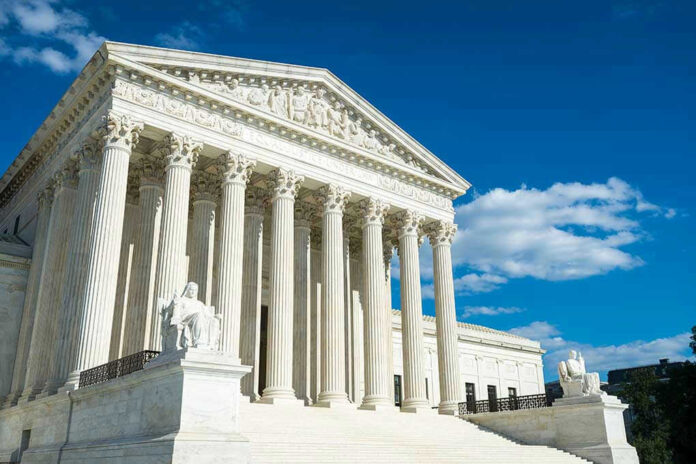
The Supreme Court’s latest move leaves Florida’s immigration crackdown in legal limbo—while the border crisis keeps boiling over, the state’s hands are tied, and the federal government keeps ducking responsibility.
At a Glance
- The Supreme Court refused to let Florida enforce its tough new immigration law, keeping it blocked while lawsuits continue.
- Florida’s law, SB 4-C, would have made it a state crime for illegal immigrants to be present—mirroring federal statutes, but the courts say states can’t do that.
- Leftist groups cheered the decision, saying it protects immigrant rights, while Florida officials decried the ruling as another blow to state sovereignty and border security.
- The border crisis continues nationwide, with millions of illegal crossings, yet states like Florida are stopped from acting when the feds refuse to do their job.
Supreme Court Sides with Federal Power—Florida Law Remains Blocked
The Supreme Court’s refusal to reinstate Florida’s SB 4-C law is just the latest proof that, in 2025, state governments have been reduced to spectators while Washington fumbles the border crisis. SB 4-C would have made it a crime for illegal immigrants to enter or remain in Florida, authorizing local police to do what the federal government seems uninterested in: actually enforcing the law. But after a coalition of activist groups sued, federal judges blocked the law, citing the old Arizona v. United States precedent that keeps immigration enforcement strictly under federal control. Florida’s Attorney General took the fight all the way to the Supreme Court, but the justices declined to intervene, leaving the law frozen and the border wide open.
This isn’t some theoretical debate. Since 2021, the number of illegal border crossings has exploded, with more than 11 million encounters and hundreds of thousands of criminals released into communities across the country. Yet, when a state actually tries to do something about it—when a state steps up to protect its citizens—the courts swoop in and say, “Not so fast, that’s the federal government’s job.” The only problem? The federal government isn’t doing it. In fact, they’re actively undermining enforcement by refusing to detain or deport most illegal entrants, leaving law-abiding Americans to pay the price.
A Legal Tug-of-War—Who Really Runs Immigration Policy?
The Florida case is part of a growing showdown between states desperate to secure their borders and a federal government that’s all but abdicated its responsibility. SB 4-C was modeled closely on federal law, simply empowering state and local law enforcement to arrest and prosecute illegal immigrants for being in Florida in violation of those same federal statutes. Yet courts have ruled, time and again, that even when Washington refuses to act, states are powerless to step in. The Supreme Court’s 2012 Arizona decision set that precedent, and the current justices—despite their supposed conservative credentials—didn’t lift a finger to revisit it.
Plaintiff groups, including the Florida Immigrant Coalition and Farmworker Association, argued SB 4-C would lead to family separations and “irreparable harm” to communities. The district court bought it, issuing a temporary restraining order in April and later a full injunction. The Eleventh Circuit doubled down, finding Florida “unlikely to succeed” because federal law preempts state action. Now, the Supreme Court’s silence signals that, for now, the lower courts’ interpretation will stand. Meanwhile, Florida’s law is dead in the water, and so is any other state’s attempt to take back control of their own borders.
Consequences for Florida—and the Nation
For Floridians, this means more of the same: illegal immigrants remain shielded from state prosecution, no matter how much chaos or cost their presence causes. Farmworker and open-borders groups are celebrating, but ordinary citizens—those footing the bill for social services, education, and public safety—are left wondering when anyone will put them first. The economic impact is immediate, with agriculture and service industries continuing to rely on illegal labor, and law enforcement left with their hands tied. The political message is crystal clear: states have no power to protect themselves when D.C. refuses to act.
The broader implications are staggering. If this case sets the precedent, other states—Texas, Arizona, you name it—will watch their own efforts to deal with the crisis get smacked down. Advocates for open borders will keep running to friendly courts, and the cycle will repeat: states try to act, courts block them, and the federal government shrugs. All the while, the American public pays the price in crime, lost jobs, strained schools, and a culture of lawlessness. The message from Washington? “Don’t worry, we’ve got it under control.” Ask anyone living near the border how that’s working out.