

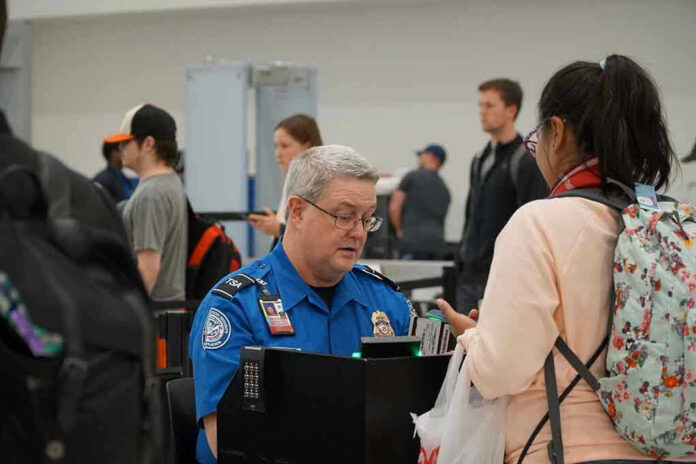
Starting this month, unprepared travelers without proper identification face a $45 federal fee just to board a domestic flight—a stark escalation from warnings to wallet hits that transforms compliance from suggestion to financial necessity.
Story Snapshot
- TSA’s new ConfirmID system charges $45 for travelers lacking REAL ID-compliant identification, effective February 1, 2026
- The fee grants only 10 days of travel validity, requiring advance online verification before arriving at the airport
- Full enforcement begins May 5, 2027, when alternative verification options may disappear entirely
- Approximately 25-30% of Americans still lack REAL ID-compliant documents, potentially generating millions in federal revenue
From Twenty Years to Fifty Dollars: The Long Road to Enforcement
The REAL ID Act took two decades to reach your wallet. Born from the ashes of September 11, 2001, Congress passed the legislation in May 2005 with a 2008 implementation deadline. That deadline came and went, then came and went again, repeatedly, as states balked at the costs and complexities. By 2020, all fifty states finally achieved compliance. By 2024, every U.S. territory followed suit. Yet even with universal state readiness, federal enforcement moved at glacial speed until May 7, 2025, when TSA finally began checking documents at security checkpoints.
The Fee Structure That Catches You Coming and Going
TSA’s ConfirmID system operates on a simple premise: pay now or prepare properly. Travelers without REAL ID-compliant licenses, state IDs, passports, or military identification must visit TSA.gov before their flight. The online verification process consumes 10 to 15 minutes and requires biometric or biographic authentication. Once completed and the $45 non-refundable fee paid, travelers receive a confirmation email valid for exactly 10 days. Frequent travelers face a stark calculation: pay $45 every 10-day window or spend an afternoon at the DMV obtaining proper identification.
REMINDER: Starting Sunday, air travelers in the U.S. without a REAL ID or another acceptable form of identification, such as a passport, are subject to a new fee of $45. https://t.co/A2HaUYONQw
— News10NBC (@news10nbc) February 1, 2026
The 10-day validity window reveals the system’s true intent. TSA designed this structure not as a sustainable alternative but as a financial nudge toward compliance. Business travelers making multiple trips monthly could spend hundreds annually on ConfirmID fees, while a REAL ID costs approximately $30 to $50 as a one-time expense. The math pushes procrastinators toward DMV offices, exactly as intended. Steve Lorincz, TSA Deputy Executive Assistant Administrator for Security Operations, clarified that even with online verification and payment, TSA officers retain absolute discretion to deny checkpoint access if identity verification fails in person.
Who Bears the Burden of Bureaucratic Transition
The financial barrier hits hardest where government programs typically do: among low-income families, elderly citizens, and rural populations with limited DMV access. Obtaining REAL ID requires multiple documents—birth certificates, Social Security cards, proof of residency—that many Americans lack or cannot easily retrieve. For someone living paycheck to paycheck, even a $30 DMV fee represents a significant expense. Adding the complexity of gathering certified documents, taking time off work, and traveling to often-distant DMV offices transforms a simple identification update into a multi-day ordeal.
The economics create a two-tiered travel system. Affluent travelers with passports sail through security without noticing the change. Middle-class travelers invest one DMV visit to secure long-term compliance. But lower-income travelers face repeated $45 fees or forego air travel entirely. This regressive impact mirrors other federal fee structures that disproportionately burden those least able to navigate bureaucratic requirements. The system assumes access to computers for online verification, reliable internet connections, credit cards for payment, and sufficient advance planning to complete the process before spontaneous travel needs arise.
The Revenue Mechanism Behind Security Theater
TSA transformed identity verification from a security function into a revenue stream. If 20 to 30 percent of the approximately 900 million annual domestic passengers lack compliant identification, and even 10 percent opt for ConfirmID rather than obtaining proper documents, TSA generates tens of millions in annual fees. The agency initially proposed an $18 fee in November 2025, then increased it to $45 by February 2026—a 150 percent jump that suggests either underestimated administrative costs or opportunistic revenue maximization. The non-refundable nature of the fee means travelers who complete verification but still face denial at checkpoints lose their money without recourse.
What Happens When the Grace Period Ends
The current system operates under “flexible enforcement” lasting until May 5, 2027. During this grace period, TSA may issue warnings rather than outright denials. After that date, travelers without compliant identification face potential airport lockout regardless of their willingness to pay fees or undergo additional screening. This approaching deadline creates urgency while the ConfirmID option remains available. Once full enforcement begins, the federal government will have established the infrastructure, precedent, and public acceptance for mandatory biometric identity verification systems across transportation networks. The REAL ID Act’s security standards—digital photograph capture, electronic database maintenance, document verification protocols—establish frameworks easily expandable to other contexts beyond aviation.
Airlines publicly support REAL ID requirements as security enhancements while privately coordinating with TSA to minimize operational disruptions. Checkpoint delays cost airlines money through missed connections, customer dissatisfaction, and staffing adjustments. The industry’s measured endorsement reflects recognition that federal security mandates are inevitable, making cooperation more productive than resistance. This pragmatic acceptance leaves travelers without organized advocacy against fee structures or implementation timelines that prioritize revenue and compliance over accessibility.
Sources:
Real ID Requirements: TSA to Enforce Fee – ABC News
Real ID Information – Airlines for America
Real ID Required for US Travelers Beginning May 7, 2025 – Department of Defense Travel
Real ID – Pennsylvania Department of Motor Vehicles