
A Toronto cop was killed serving a warrant tied to a U.S. Consulate shooting, and the facts are already racing behind the narrative.
Story Snapshot
- Officer from Toronto’s Emergency Task Force killed during a planned warrant raid linked to a U.S. Consulate attack
- Police say the raid targeted suspects from a white Honda CR‑V drive‑by on the consulate, called a “national security incident”
- One suspect is in hospital, another named suspect is on the run; no public proof yet of who fired the fatal shot
- Key evidence like the warrant, ballistics, and body‑cam remains sealed while the Special Investigations Unit is active
A national security gunfight lands in a Toronto hallway
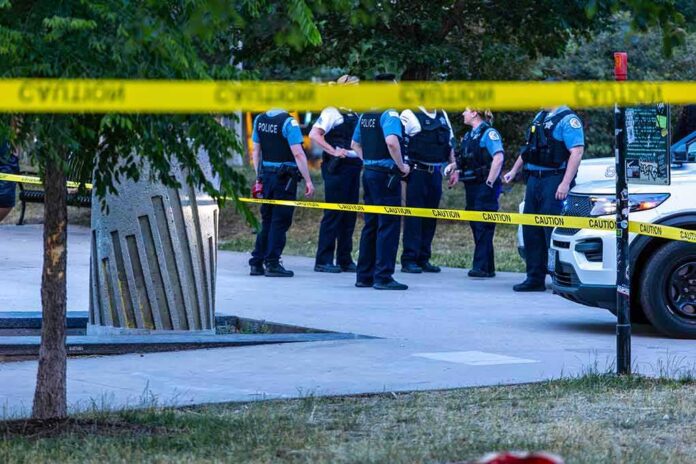
Toronto’s police chief says his fallen officer died in a lawful, planned raid, not a random street scuffle. Reports describe an Emergency Task Force team hitting several addresses at dawn, hunting those behind a March attack on the U.S. Consulate downtown.[2][3][4][7] During one of those warrants, gunfire erupted in an apartment building. The officer was shot, rushed to hospital, and died. Another person, described by police as a suspect, also landed in emergency care.[2][4][7]
Police say these were “high‑risk takedowns,” the kind of operation that gets Toronto’s most trained tactical unit sent in first.[2][7] The chief stressed that officers were executing judicially approved search warrants when shots rang out. That detail matters. It frames the story as lawful state action met by armed resistance, not a shaky stop gone wrong. But the warrants themselves, the affidavit that justified them, and the judge’s order are not public in the record you and I get to see.[2][3][4][7]
From a 4:29 a.m. drive‑by to a daytime death
The March shooting that triggered all this barely nicked the news cycle when it happened. Around 4:29 a.m., a white Honda CR‑V pulled up outside the U.S. Consulate on University Avenue.[1][3][4] Two men got out, fired multiple handgun rounds into the fortified building, and took off into the dark.[1][3][4] No one inside was hurt, but the building was damaged, shell casings littered the scene, and federal officials quickly branded it a “national security incident.”[1][3][4]
The Royal Canadian Mounted Police said they activated their national security teams and were working with American partners, including the Federal Bureau of Investigation.[1][3][4] They also said something else that should stick with you: at that early stage, they did not yet know if this was terrorism, some grudge, or something stranger.[1][3][4] That question never left the investigation. Months later, when Toronto’s tactical officers hit those apartments, the chief linked the operation directly back to that consulate attack.[2][3][4][7] The full bridge in evidence between the white SUV at 4:29 a.m. and the fatal gunfight at a Toronto door has not been laid out in public filings.
The suspect, the shooter, and the missing proof
Media reports all repeat the same core police line: one suspect was shot and is in hospital; another, nineteen‑year‑old Zara Jabbi, is at large, considered armed and dangerous.[2][3][5][6][7] Where the details thin out is at the hardest question in the case. Who fired the shot that killed the officer? Here the police chief, for once, did not rush ahead of the evidence. In the full news conference, he declined to say that Jabbi was the shooter and said the ongoing investigation would have to answer that.[7]
"@TorontoPolice Emergency Task Force officer killed executing search warrant.
The warrant was related to the investigations of shootings at the @usconstoronto & greater @cityoftoronto area synagogues." @joe_warmington #Toronto
— fan of Blue Jays (@77BlueJays) June 11, 2026
No outlet in your research shows a ballistic report or an autopsy tying one weapon, or one person, to the fatal round.[2][3][4][5][6][7] There is no released body‑cam video, no Special Investigations Unit summary, no charging document spelling out which suspect did what. Early coverage scrambles even basic facts like the fallen officer’s name, with spelling variants sprinkled across reports.[2][3][5][6][7] That kind of sloppiness is normal in breaking news, but it should make any careful reader tap the brakes before repeating polished social‑media claims about exactly who killed whom and why.
Why the first story always comes from the same side
People who lean on common sense and conservative instincts tend to give cops the benefit of the doubt. That is not blind faith; it is a reading of risk. Statistics Canada found 133 Canadian officers murdered in the line of duty from 1961 to 2009, nine out of ten by gunfire. More recent work shows hundreds of officers dead on duty overall, many in car crashes but a large share shot. When an officer dies in a gunfight, odds are he was facing real danger, not a made‑up threat.
At the same time, Canadians have learned that the first official story is rarely the last. Civilian researchers and media have documented more than 460 civilians killed in encounters with police between 2000 and 2017, most by police gunfire. A newer project found police‑involved deaths of civilians rising by more than sixty percent after 2010. Those numbers do not prove police are trigger‑happy monsters. They do show that whenever bullets fly, state power has to answer hard questions, in detail, under oath.
What accountability should look like in this case
For this raid, real accountability is not about hashtags. It is about documents and forensics that either confirm or correct the early narrative. The public should eventually see the search warrant and the sworn information officers gave a judge to justify it. That would show how strong the link was between the targeted apartments and the consulate shooting.[1][2][3][4][6][7] Ballistic and autopsy reports should say which gun fired the fatal shot and from where. Body‑cam, hallway cameras, and radio traffic can map who moved first and who opened fire.[2][3][4][7]
Ontario’s Special Investigations Unit will likely release some version of that record when it closes its case. Past rulings from the unit have cleared officers when the evidence shows they faced imminent lethal threat, and they have criticized forces when facts did not match the early spin. Until then, a sober, conservative approach does two things at once. It honors a fallen officer who went through the door knowing guns were likely on the other side. And it refuses to lock in unproven claims about a young suspect or a “terror” motive before the evidence is on the table, not just on the podium.
Sources:
[1] Web – Toronto cop shot dead while investigating US consulate attack: police …
[2] Web – UPDATED: Toronto police officer killed during raid related to March …
[3] Web – A Toronto police officer was shot during an exchange of gunfire in …
[4] Web – Toronto Police Officer Is Killed in Operation With U.S. Link
[5] Web – Police officer in Toronto killed in shooting linked to investigation …
[6] Web – Officer shot and killed while investigating US Consulate attack, …
[7] Web – Toronto police officer dies in raid linked to US consulate shooting
© horizonpost.com 2026. All rights reserved.