
American pilots just turned the memory of three murdered countrymen into a named campaign that tells every jihadist on earth: if you shoot at us, you do not get to die of old age.
Story Snapshot
- Operation Hawkeye Strike ties massive U.S. airpower directly to the killing of two Iowa Guardsmen and their interpreter near Palmyra.
- Central Command is openly promising would‑be attackers: “We will find you and kill you anywhere in the world.”
- A post‑Assad Syrian government has now joined the anti‑ISIS coalition, reshaping how Washington fights ISIS on Syrian soil.
- Large‑scale strikes across Syria signal a doctrine of swift retribution and relentless pressure, not a token response.
Retaliation With A Name, A Face, And A Message
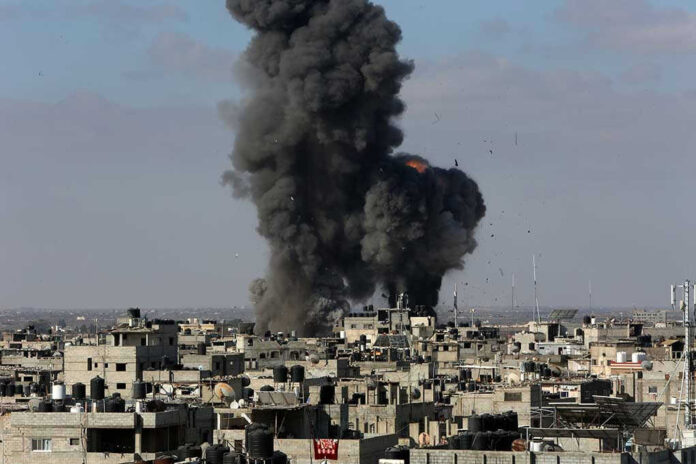
U.S. jets did not just bomb coordinates on a map; they launched a named operation built around the home state of the men ISIS tried to vanish into a casualty report. Operation Hawkeye Strike began after an ISIS‑affiliated gunman ambushed a U.S. convoy near Palmyra on December 13, killing Iowa National Guard Sergeants Edgar Brian Torres‑Tovar and William Nathaniel Howard, along with interpreter Ayad Mansoor Sakat. CENTCOM answered with airpower and a promise that justice would not be abstract.
Central Command framed the response in language that leaves no room for diplomatic spin: if you harm American warfighters, U.S. forces will “find you and kill you anywhere in the world, no matter how hard you try to evade justice.” That blunt threat aligns with a basic conservative instinct: deterrence only works when consequences are not theoretical. By making the operation’s name a tribute to the Hawkeye State, planners tethered grand strategy to a folded flag handed to a family in Iowa.
From One Ambush To Seventy Targets
Six days after the Palmyra murders, the first large‑scale wave under Hawkeye Strike hit roughly seventy ISIS targets across central Syria, conducted jointly with Jordanian forces. Weapons depots, infrastructure, and support nodes that fed ISIS cells were on the target list, a shift from single‑target raids to broad strikes designed to sap operational momentum. Over the next ten days, eleven missions killed at least seven ISIS members, captured others, and destroyed four weapons caches. The tempo signaled intent to grind, not just to gesture.
Commanders paired bombs with a clear doctrine: this was not vengeance for domestic consumption alone; it was force protection by example. ISIS thrives on the belief that it can bloody Americans and melt back into the desert. Each raid, each cache destroyed, undercuts that mythology. From a common‑sense standpoint, allowing any group to think it can kill U.S. personnel without disproportionate cost is an engraved invitation to more ambushes on the next dusty road.
A New Syria Changes The Battlefield Mathematics
The strikes unfolded in a Syria that looks very different from the one many Americans remember from nightly news a decade ago. Bashar al‑Assad was ousted in December 2024; his successor, President Ahmed al‑Sharaa, has brought Damascus into the global coalition against ISIS. U.S. envoy Tom Barrack recently met al‑Sharaa and senior officials in Damascus to discuss the country’s transition, security, and coordination against ISIS, anchoring Hawkeye Strike in a broader political realignment.
That cooperation adds a new layer to the long‑standing partnership with the Kurdish‑led Syrian Democratic Forces, whose fighters carried much of the ground burden in dismantling the ISIS caliphate. Now, coalition planners weigh intelligence from both SDF units and elements of the new Syrian security forces. For American conservatives wary of endless nation‑building, this evolution matters: it hints at a model where a smaller U.S. footprint leverages local states and militias to keep ISIS suppressed, instead of repeating the pattern of large occupations with vague exit strategies.
Deterrence, Limits, And The Long War Against Cells
Large‑scale strikes are not a magic eraser; ISIS shifted from territorial rule to insurgent cells years ago, surviving by blending into civilian populations and desert terrain. History shows that airstrikes alone rarely eliminate such networks. Yet, when those strikes follow a clear red line—kill Americans, lose your safe houses and commanders—the calculus for any would‑be attacker changes. The reported arrest of ISIS’s military leader for the Levant, just before the latest wave, further complicates the group’s ability to coordinate.
The core question for U.S. voters is not whether ISIS deserves this treatment; that debate largely ended when the group burned pilots alive and enslaved minorities. The real issue is whether America maintains the will to apply targeted, sustained pressure without drifting into either performative restraint or open‑ended reconstruction projects. Hawkeye Strike sketches a path that many on the right would recognize as common sense: keep a modest force forward, hit terrorists hard when they strike, rely on local partners for ground work, and make sure every ambush ends with the hunters on the run.
Sources:
US carries out additional ‘large-scale’ strikes on ISIS targets in Syria – ABC News
US launches retaliatory strikes against ISIS in Syria – Military Times
US launches attack against ISIS in Syria – KOMO News
Timeline of the Islamic State (2025) – Wikipedia