horizonpost.com — A car exploding into a fireball beside Wall Street’s Charging Bull tells you more about modern media than it does about fire.
Story Snapshot
- A dramatic vehicle fire near New York City’s Charging Bull sent black smoke over Lower Manhattan but injured no one [1][2]
- Multiple outlets and viral videos agree on the basic facts yet leave major questions unanswered about cause and responsibility [1][2]
- Short-form clips turn a routine urban hazard into a global panic reel within minutes [2][3]
- The gap between spectacle and verified detail shows why citizens need more skepticism and less click-chasing
The explosion that turned Wall Street into a movie set
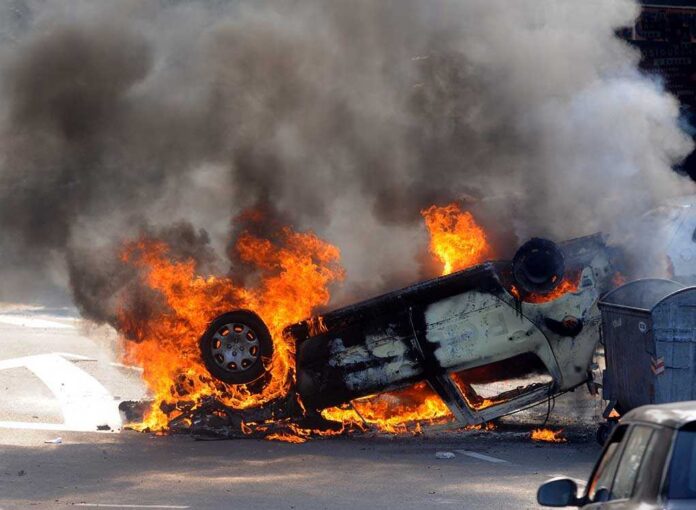
New Yorkers on their evening commute watched a car by Broadway and Stone Street transform into a rolling action scene, flames shooting up and smoke swallowing the canyon of the financial district [1][2]. Reporters at the scene described a vehicle that “caught fire and exploded” near the Charging Bull statue, one of the most photographed symbols of American capitalism [1]. Tourists with phones out reacted before any reporter did, feeding the first images into the social bloodstream.
Fire Department of New York crews arrived around 5:42 p.m. and fought the blaze for more than an hour, finally bringing it under control just before 7 p.m. [1][2]. Photos afterward showed what you would expect when fuel, plastics, and wiring meet sustained heat: a completely torched shell, metal warped and interior reduced to char [1]. The extraordinary part of this story is not the destruction of the car. It is that, despite the violence of the scene, no injuries were reported at all [1][2].
What we actually know versus what we think we saw
Media reports and videos line up on several key facts. They place the incident at or near the intersection of Broadway and Stone Street, just steps from the Charging Bull statue [1][2]. They show a vehicle engulfed in flames, followed by a violent flare-up many headlines simply call an explosion [3]. They note thick black smoke spreading across the financial district, stopping pedestrians and filling social feeds in real time [1][2]. All of that is well supported by independent outlets and footage.
Beyond that, the record becomes a fog bank. Reporters confirm no cause has been determined, and they quote fire officials as saying the cause remains under investigation or unknown [1][2]. No source in the current record definitively states who owned the vehicle, whether it was parked or moving, or what systems failed first [1][2]. Some captions online speculate that the car was related to city transit, but those descriptions use hedged language such as “reportedly linked” or “appeared to be,” without corroboration from any official document [2][3]. From a common-sense conservative perspective, that sort of weasel phrasing should trigger skepticism, not certainty.
How a routine urban hazard becomes a global panic clip
Fire investigators know that cars burn more often than most people realize. Fuel leaks, electrical shorts, poorly maintained batteries, and aftermarket modifications can all ignite under the right conditions. Early media coverage rarely distinguishes between a dramatic fire and a true explosion; if the vehicle produces a loud report and a fireball, “exploded” becomes the default verb, even though investigators later separate fire from deflagration based on forensic evidence, not camera angles [1]. The public, however, rarely sticks around for that slower, more technical answer.
Short-form video platforms intensify that disconnect. The incentives push toward maximum spectacle and minimum nuance. Calling an event “massive” or “terrifying” pays better in clicks than saying, “Vehicle fire of unknown cause, more details pending.” Producers understand that a flaming car beside a famous statue will outrun any calm follow-up in a matter of minutes [2][3]. Citizens who want honest information must now do what reporters once did for them: compare accounts, watch for qualifiers, and distinguish verified facts from convenient drama.
The missing pieces that actually matter
The largest holes in this story are not about the flames; they are about responsibility. There is no publicly available fire department incident report, police complaint record, or transit fleet statement in the current set of sources [1][2]. Without those, no one outside the investigation can say whether this was aging equipment finally failing, a maintenance oversight, a freak accident, or something deliberate. Anyone claiming certainty about motive or blame at this stage is choosing narrative over evidence.
Chaos erupted near the Charging Bull statue in Lower Manhattan after a parked car burst into flames and exploded near the busy tourist area
Officials say fire appears to have started in the car before the explosion Investigators are now working to determine exactly what caused it pic.twitter.com/8b2gbs8wsh— NYC News 24 🗞️ (@NYCNews24) May 21, 2026
For citizens who still care about accountability, the right questions are straightforward. Did investigators determine a specific ignition point in the engine bay or electrical system? Were there prior service records flagging risks for this vehicle or similar models? If the car belonged to a government agency, are there internal memos about budget-driven shortcuts that increased fire risk? None of those questions get answered by a viral thirty-second clip. They get answered by patient work, public records, and pressure from people who refuse to be satisfied with spectacle.
Sources:
[1] Web – Car catches fire and explodes near New York’s Charging …
[2] Web – Car Explodes in Lower Manhattan, Billowing Smoke Fills …
[3] YouTube – Car catches fire and explodes near Charging Bull statue in …
© horizonpost.com 2026. All rights reserved.