
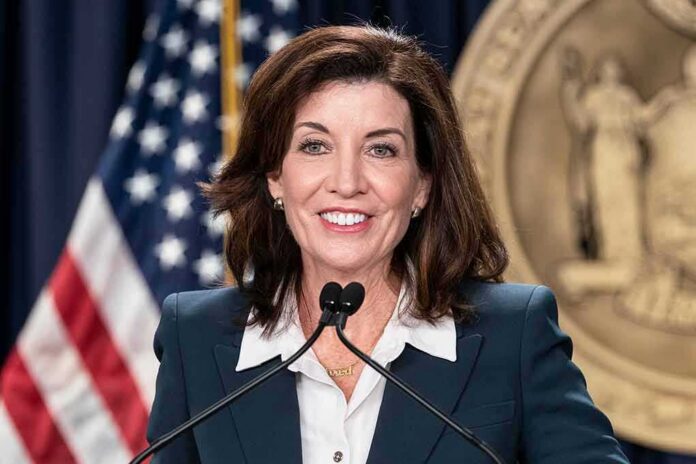
Bruce Blakeman turned a policy fight into a gut-check question: are New Yorkers funding a system that attracts and shields unlawful migration?
Story Snapshot
- Blakeman says Governor Kathy Hochul protects and funds services for undocumented migrants.
- Hochul advanced state programs and laws that include undocumented immigrants in services and legal shields.
- Courts blocked New York City’s bid to let certain noncitizens vote in local races.
- Studies find sanctuary policies do not raise overall crime, but deportations drop.
What sparked the clash and why it matters now
Bruce Blakeman used the governor’s debate to frame a clear choice on immigration and public spending. He charged that Governor Kathy Hochul blocked deep cooperation with federal immigration enforcement and poured billions into benefits for people here unlawfully. He tied that claim to voter power by pointing to Democratic allies who tried to extend local voting to noncitizens. Voters heard a simple test: does Albany’s approach invite more unlawful crossings, or keep order and fairness for taxpayers?
Hochul’s record includes building legal and service networks that cover immigrants regardless of status. Her administration launched New York State’s Institute for Immigration Integration Research and Policy to connect immigrants, including the undocumented, to education and work. She also backed laws that deter threats to expose immigration status by labeling those threats as coercion or extortion. Supporters call this humane and practical. Critics call it an incentive that signals rule-bending will be met with benefits.
Money, mandates, and the message government sends
Blakeman’s line of attack stuck to the ledger and the badge. He said the state handed out housing, transport, and help that taxpayers did not approve and linked these to weaker cooperation with federal immigration agents. From a conservative view, the logic is direct: government should not subsidize violations, and it should not block officers from working with federal partners. Sanctuary-style limits may feel good, but they can blur the boundary between compassion and complicity.
Hochul’s allies counter that families and kids still need food, lawyers, and school seats while federal cases move. They argue that local police earn trust when they focus on crime, not civil immigration status. Research gives them cover: peer-reviewed work finds no rise in violent or property crime in sanctuary areas, while deportations do fall. Crime is not the only metric that matters to voters, though. Visible costs, shelter strain, and street disorder often decide elections more than charts ever will.
The voting-rights crosswind that confuses the issue
New York City leaders tried to let certain legally present noncitizens—like green card holders—vote in municipal races. That plan never covered state or federal elections and did not include undocumented immigrants. The New York Court of Appeals struck it down, citing state law that limits voting to citizens. Fact-checkers also stress that noncitizens cannot vote in statewide or national races, and voting by noncitizens in federal elections is a crime. The legal lane here is narrow and, for now, closed.
Blakeman still links the push to a larger pattern: expand services, soften enforcement, and widen local political voice. Even if the courts shut one door, the pressure to revisit local rules or push state changes remains. From a common-sense frame, the cleanest rule is also the clearest: voting is for citizens. If government blurs that line, trust in elections weakens fast, even if the policy never touches state or federal ballots.
How voters should score the trade-offs
Three questions cut through the noise. First, do state-funded benefits for undocumented migrants ease chaos or invite more? The moral urge to help is real; so are budget limits. Second, do sanctuary rules help police solve crimes or create safe harbors for repeat offenders? The best studies show no crime surge, but people judge safety block by block, not by averages. Third, does any policy widen noncitizen voting? Courts say no in New York, and federal law backs that bright line.
"We will no longer be a sanctuary state when I become governor."
Bruce Blakeman, who's challenging Gov. Kathy Hochul in November, vows to overhaul New York's immigration policies on "Hannity," claiming the state spends $81,000 per illegal migrant.
"It's a tragedy. It's wrong,… pic.twitter.com/rmra0pEpd4
— Fox News (@FoxNews) October 15, 2026
Policy should match two guardrails most New Yorkers share. Enforce the law with firmness, speed, and fairness. Protect core services for citizens and legal residents, while meeting urgent humanitarian needs in ways that do not become a magnet. That means closer work with federal agencies on removals for those who break laws, strict spending oversight, faster work authorization where legal, and an ironclad rule that voting belongs to citizens only. Results, not slogans, will decide this fight.
Sources:
governor.ny.gov, timesunion.com, breitbart.com, oleantimesherald.com, nypost.com, nydailynews.com
© horizonpost.com 2026. All rights reserved.