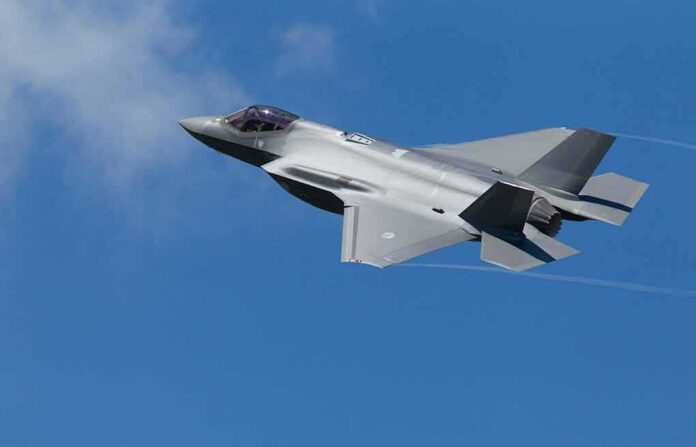
A missed email let parts of America’s stealth fighter ride a brown truck into China’s hands.
Story Snapshot
- Pentagon officials confirmed an F-35 shipment problem and launched a recovery push.
- Reports say a canopy and a weapons-bay door bound for the United States were diverted to Hong Kong.
- Bloomberg linked the detour to a shipping email that was ignored, not espionage.
- Government audits show years of weak tracking for F-35 spare parts.
What Actually Moved, Where It Went, And Why It Matters
U.S. defense officials said they are working to recover F-35 components after a shipment went off course and reached Hong Kong. The F-35 Joint Program Office stated it is investigating the incident and putting in new safeguards to prevent a repeat. Bloomberg reported the cargo as a cockpit canopy and a weapons-bay door from an Australian F-35 that were headed to the United States for inspection, repair, or disposal when the shipment was diverted.
Reports said the package transited South Korea before it was routed to Hong Kong, where Chinese authorities later took possession and have not returned the parts. Bloomberg’s defense reporter said the diversion looked like a shipping error, not a planned handoff, and noted the parts did not include core avionics. Still, these pieces carry radar-absorbing coatings and design cues that the United States prefers to keep close.
How A “Do Not Route” Warning Became A Door To Risk
Subsequent reporting tied the mistake to a missed email. A logistics firm warned the carrier not to send the package through Hong Kong due to export rules. A carrier employee allegedly missed that message, and the shipment went anyway. That sounds like a small blunder. It is not. When the world’s most advanced fighter relies on global couriers and inbox discipline, a single click can create a national security headache that takes months to unwind.
Lockheed Martin and the Defense Department say they are working with authorities to get the parts back and tighten controls. That is necessary and expected. The larger question is why a system with this much money and technology allows a single routing error to outpace oversight. American conservative values prize accountability that prevents repeated waste and risk. Process that depends on luck instead of discipline fails that test.
The Pattern: Years Of Fog Over F-35 Spare Parts
Auditors at the Government Accountability Office found in 2023 that the F-35 program lacks full visibility into millions of spare parts. The Department of Defense owns many of these parts, but contractors manage the global pool. The Joint Program Office could not say how many parts it had or where exactly they were at non-prime contractor sites. Losses measured in more than a million parts and tens of millions of dollars followed from that blind spot.
That was not the first warning. In 2019, the Government Accountability Office said the department did not keep a complete database of F-35 parts it owned, or their locations, and needed to close gaps in supply performance and global movement. Years later, many metrics still missed targets, and repair timelines stayed long. The shared global pool model removed clear lines of duty. When many are in charge, no one is in charge.
What China Could Learn And What It Probably Cannot
The shipped canopy and bay door are not the jet’s brain. They do not include the fused sensors, mission computers, or electronic warfare suite. They do include shape, materials, and coatings that reduce detection. Those features are sensitive. Engineers study such items to refine radar models and test counter-stealth ideas. That is the risk. It is not a blueprint dump, but it is a data point the Chinese military would value.
Two Australian F-35 parts were reportedly sent through Hong Kong to save time, despite an email warning against that route.
Bloomberg’s 7th October report, citing a person briefed on the incident, describes how a cockpit canopy and weapons-bay door bound for the US took the… pic.twitter.com/TR9vARyL4r
— World Monitoring Center (@WMC_WORLD) October 8, 2026
Supporters of the “low risk” view cite the parts’ condition and lack of embedded electronics. That is fair context. But low risk is not no risk. The real lesson is less about any single panel and more about the soft underbelly of logistics. Adversaries do not need to break into a vault if they can wait at a transfer hub. Supply chains are the new attack surface. We must harden them like we harden code and airframes.
Fix The System: Clear Custody, Fewer Hands, Faster Flags
Congress and the Pentagon should draw a straight line from audits to action. First, establish government-run tracking that logs every F-35 part location, custody handoff, and export constraint in real time. Second, reduce third-party links for controlled items; fewer hands mean fewer seams. Third, build hard stops into routing systems so disallowed transits cannot be booked, even by mistake. Fourth, link rapid alerts to diplomats and investigators when a package strays.
These are simple, common-sense steps. They match a conservative approach to stewardship: know what you own, guard it tightly, and measure performance. The F-35 is a crown jewel the United States cannot afford to dull through sloppy logistics. If a missed email created this mess, mandated verification should prevent the next one. The cost of discipline is small. The cost of another detour could be steep and permanent.
Sources:
military.com, gao.gov, washingtonexaminer.com, defensenews.com, bloomberg.com, finance.yahoo.com
© horizonpost.com 2026. All rights reserved.