
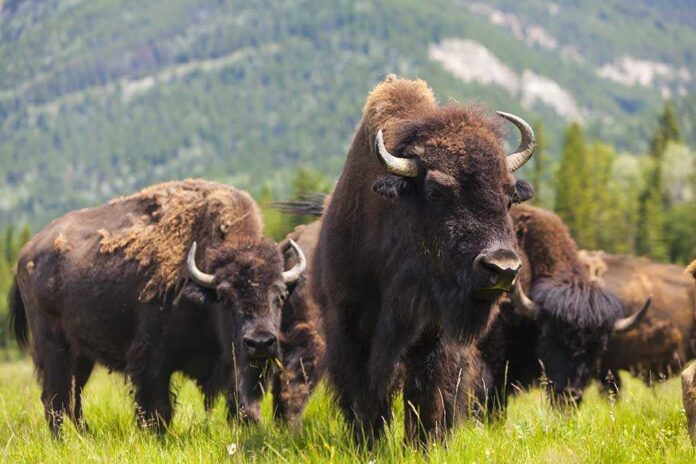
A huge Yellowstone bison casually lowered its head, launched a man into the air, and reminded America that the “fluffy cow” joke ends fast when you ignore 25 yards of common sense.
Story Snapshot
- Yellowstone bison injure more people than any other animal in the park, year after year.
- Park rules demand at least 25 yards from bison, yet visitors keep edging closer anyway.
- Most serious bison injuries happen after people choose to approach the animal on purpose.
- Viral videos reward risky selfies and stunts more than basic respect for wild creatures.
Yellowstone bison are not props for tourist entertainment
The viral clip of a Yellowstone bison sending a man flying looks like a freak moment, but it fits a long, ugly pattern. Since 1980, bison have injured more people on foot in Yellowstone than any other animal, including bears, which get most of the fear and headlines. These animals weigh up to a ton, accelerate like a pickup truck, and have horns designed by nature to solve problems fast. The park bluntly warns that bison can run about three times faster than you.
Yellowstone’s own safety page spells it out in plain language: stay at least 25 yards from bison and other large animals, and 100 yards from bears, wolves, and cougars. That 25-yard rule is not a suggestion. It is a regulation, and it is illegal to willfully stay close enough to disturb or move wildlife. Park partners, guides, and even fan pages repeat the same distance because they see what happens when people treat that rule like a dare instead of a boundary.
Most bison injuries start with a bad human decision
Federal health data on bison injuries in Yellowstone show a striking pattern: the vast majority of victims walked toward the animal. One peer-reviewed study found that 80 percent of bison injuries happened when people approached bison, usually to take photos or get a “closer look.” A Centers for Disease Control and Prevention review of 2015 cases described visitors turning their backs for selfies just a few feet from a bison, then being gored. That is not “nature being random.” That is human stubbornness.
From 1978 through 1992, Yellowstone averaged about four bison-related incidents per year, including two deaths. After 33 injuries in just three years in the early 1980s, the park ramped up warnings and education. Injuries dropped, but they never vanished, because there is always some visitor ready to test the limits. In recent years, the park still reports multiple bison gorings each season, almost always tied to people getting far too close.
Why the 25-yard rule exists, and why it is conservative common sense
The 25-yard rule is not “woke wildlife policy.” It is basic physics and biology. A bison can close 20 yards faster than most people can turn and run, and you will not win a sprint. Yellowstone’s safety guidance says to turn around or back away if a bison comes within that distance. Rangers and educators tell visitors to use zoom lenses, stay on boardwalks, and never walk into meadows where animals are scattered like land mines of muscle.
For people who value human life and personal responsibility, this is simple: you do not sacrifice your family’s safety, or force an animal to be killed, just to get a closer video. When visitors approach bison and get hurt, rangers sometimes have to put the animal down if it keeps reacting to humans as threats. That is a double tragedy. A reckless choice risks your life and may destroy a healthy wild animal for doing exactly what it evolved to do when something invades its space.
Warning signs and the lie of “they looked calm”
Many injured visitors later say, “The bison looked relaxed.” That is the same false comfort people use around big dogs they do not know. Yellowstone and tribal buffalo outreach programs list clear warning signs: staring directly, turning to face you, swinging the head, pawing the ground, lifting the tail, making short bluff charges. These are red lights, not gentle hints. A charge often follows, and the animal does not stop because you meant well.
A bison gored a 12-year-old at Yellowstone in the park’s first attack this year https://t.co/EEWBbbpcwd Perhaps I missed it in the story but……Where the heck were the so-called parents?
— Delbert Earl Myers (@delbert_earl) July 10, 2026
Online communities joke, “Don’t pet the fluffy cows,” but they know the stakes. Every year, videos show tourists walking up to bison like they are farm animals. Some are lucky. Some are not. Social media channels that chase clicks love these clips. Algorithms reward shock and “hold my beer” moments. Meanwhile, sober safety messages, long captions about distance rules, and science-based studies on injury patterns get buried under the next viral goring.
Viral spectacle versus real respect for wild places
The latest headbutt video will fade, replaced by another clip of someone ignoring basic rules. What will remain is the quiet work: Yellowstone rangers issuing tens of thousands of warnings each year for people getting too close, feeding animals, or disturbing wildlife. The park keeps repeating the same sentence because many visitors refuse to hear it the first time. Stay at least 25 yards from bison. Not “if they seem agitated.” Every time, every animal, every visit.
A conservative, common-sense view of Yellowstone is plain. Wild animals belong in the wild, not in your selfie. Freedom in a national park does not mean freedom from consequences. When you step past the 25-yard line, you make a choice that can maim you, scar your kids, and cost an animal its life. The bison does not read the rules. You do. And when you ignore them, gravity, horn, and hooves take over the story.
Sources:
thegatewaypundit.com, oldfaithfulrvpark.com, nps.gov, discoverytreks.com, yellowstonesafari.com, facebook.com, stacks.cdc.gov, yellowstone.org, windriverbuffalo.org, cdc.gov
© horizonpost.com 2026. All rights reserved.