
Campaign rallies are designed to project momentum; the measure of a seasoned candidate isn’t whether dissent appears, but how quickly the event absorbs the disruption and reasserts control.
At a Glance
- During a Myrtle Beach rally backing Darline Graham’s Senate bid, President Trump was briefly interrupted by hecklers and resumed after security removed them.
- Trump answered with a one-liner and kept the program moving—a familiar, practiced response that turns a break in message into crowd-rallying theater.
- Video and wire reports confirm the interruption, removal by security, and Trump’s quick pivot back to the stump.
- The episode sits squarely in the long-running tension between a speaker’s right to proceed and protesters’ right to dissent—without tipping into a “heckler’s veto.”
What Happened in Myrtle Beach—and Why It Matters
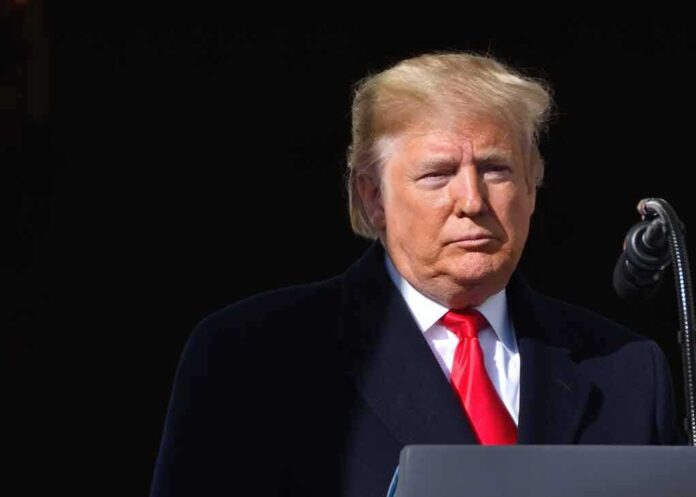
The setting was straightforward: a campaign rally at the Myrtle Beach Convention Center in support of Darline Graham’s bid for her late brother’s U.S. Senate seat. Mid-remarks, protesters broke the flow; security moved to remove them as the crowd reacted. Trump paused briefly, tossed a quip—essentially dismissing the intruder—and continued the event. The wire copy and video from the scene are consistent on the essentials: interruption, swift removal, and a controlled return to the program. For an incumbent president on the trail, that sequence isn’t anomalous; it’s the script for managing dissent inside a ticketed or otherwise controlled rally environment.
That the protesters’ attire drew attention—one wore a shirt with a violent slogan—mattered less than the operational choreography. A campaign’s job in the room is to keep the microphone with the speaker and the story with the candidate; the tactical goal is seconds of disruption, not minutes. In Myrtle Beach, that’s what happened: a short flare of noise, a practiced rejoinder, and the stump speech regains gravity.
How Campaigns Manage Disruption: The Mechanics
Modern rallies are equal parts message delivery and crowd management. Venues are secured in layers—credentialed entry, visible police or contracted security, and the Secret Service’s protective protocols when the president appears. Inside the hall, staff and security identify potential disrupters (signs, coordinated chants, or visual cues) and position to act if an interruption begins. Once a heckler engages, the playbook is simple: get eyes on the protester, move quickly to an exit, give the crowd a focal point (the stage) rather than the aisle, and prompt the principal to keep talking. The one-liner is not frivolous; it’s a control device that funnels audience attention back to the podium while signaling confidence.
The legal posture is well-worn. The First Amendment protects political speech and, within limits, dissent; it does not guarantee a right to commandeer a private or permitted event. Courts have repeatedly treated the removal of disruptive attendees as compatible with the speaker’s own expressive and associational rights, so long as ejection doesn’t blend into unlawful force or incitement to imminent violence. Appellate rulings arising from earlier Trump-era litigation framed a candidate’s “get them out of here” exhortation as protected advocacy, not an instruction to commit battery, when unaccompanied by calls for unlawful force. States also criminalize “disturbing lawful assemblies,” a doctrine that long predates the social-media era and applies neutrally to rallies across the political spectrum.
The Pattern: Why A Brief Heckle Becomes a Big Story
Heckling is banal; framing is not. In contemporary campaigning, a few seconds of disruption can blossom—via selective clips and headlines—into a narrative about weakness or toughness, intolerance or control. That elasticity isn’t new. Scholarship on the “hostile audience” and the “heckler’s veto” has for decades grappled with the boundary where dissent morphs into suppression of speech by rendering orderly presentation impossible. The Supreme Court’s modern doctrine resists empowering the loudest voice to shut down a speaker; the operative question tends to be whether the disruption becomes substantial enough to extinguish the message or prompt unlawful audience reaction. In practice, political operations aim to prevent that threshold from ever being approached, which is why speed and ritualized responses matter.
Trump’s rallies, in particular, have habituated audiences to this dance. Disrupter appears; the crowd boos; the principal mixes ridicule with imperatives for removal; the show rolls on. That repetition creates two parallel media products: inside the room, a moment of catharsis that affirms in-group solidarity; outside, dueling narratives in which the same footage is either proof of faltering appeal or evidence of persistent opposition. What gives the Myrtle Beach instance its specific texture is the convergence of three elements: a Senate endorsement setting, visual provocation via a shirt slogan, and the quick resort to a stock ad-lib that reframed the interruption as unserious. The result was a short-lived detour, not a redefinition of the event.
🚨 FACT CHECK: No, Trump Wasn't “Heckled by His Own Crowd” in South Carolina
A viral post is claiming President Trump was “heckled by his own crowd” at Friday night's Myrtle Beach rally.
That's a pretty misleading way to describe what happened.
Trump was interrupted by a… pic.twitter.com/WjZOIHu5xQ
— 🎹 Ames™ 🎹 (@Real_Ames) August 22, 2026
The Law, the Lines, and the Room
Two legal anchors are worth keeping in view if you want to understand how these moments are policed. First, a permitted or private rally may lawfully set terms of attendance. Security removing someone who will not stop disrupting the program is, in most settings, permissible. Second, the First Amendment does not mandate that a candidate yield the floor to adversarial speakers inside the candidate’s own event. Where disputes have landed in court, outcomes have largely reinforced a campaign’s discretion to manage its environment and the limits on protest that substantially interferes with the event’s purpose—while also constraining any drift into retaliation or violence that would outstrip lawful order-keeping.
This is the balance professionals try to maintain: keep dissent visible in the broader democratic arena—on sidewalks, in counter-rallies, online—while preventing an in-room veto of the scheduled program. The aim is not content suppression; it is continuity of the scheduled speech. Campaigns that manage the beats well deny the protester the oxygen of extended attention while giving their own audience a cue: we are unruffled; proceed. The Myrtle Beach rally followed that cadence closely.
What It Means Going Forward
Episodes like this rarely change minds; they do, however, test the muscle memory of a campaign apparatus. Trump’s brief exchange and immediate pivot showed an operation comfortable with disruption and calibrated to exploit it theatrically without surrendering control. For supporters, that reads as resilience and wit. For opponents, it’s an emblem of polarization and crowd choreography. Both can be true; neither alters the bottom line for event management: the microphone stayed with the candidate, and the message resumed almost immediately.
Expect more of this. As long as rallies remain the stage on which candidates demonstrate vitality, adversaries will seek to puncture the spectacle from within. The counter is not a novel security doctrine; it is disciplined repetition—swift removal, a well-timed rejoinder, and relentless return to the through-line. In Myrtle Beach, that formula held.
Sources:
redstate.com, uk.marketscreener.com, youtube.com, reuters.com, washingtontimes.com, constitutioncenter.org, abajournal.com, reason.com, ndlawreview.org
© horizonpost.com 2026. All rights reserved.