
New York’s left didn’t just win a night; it installed a network.
Story Highlights
- Zohran Mamdani won the 2025 New York City mayor’s race with 50.78% of the vote [1][3].
- Youth voters backed Mamdani by 75%, with turnout estimates revised upward to 28% [6].
- Mamdani’s allies captured key Democratic primaries, including Brad Lander’s congressional win [11][13].
- Critics point to low overall turnout and policy shifts that test the “mandate” claim [5].
Mamdani’s Win Redrew New York’s Power Map
Zohran Mamdani entered City Hall by winning 50.78% of the vote, becoming the city’s youngest mayor in over a century and its first South Asian and Muslim leader [1][3]. He first secured the Democratic nomination under ranked-choice voting, finishing with a 56% tabulated share after starting with 44% as first-choice [4]. That path signaled a coalition candidate who gained ground on later rounds. Supporters call it a clean mandate. Skeptics counter that the margin, while decisive, still rides on a modest electorate [5].
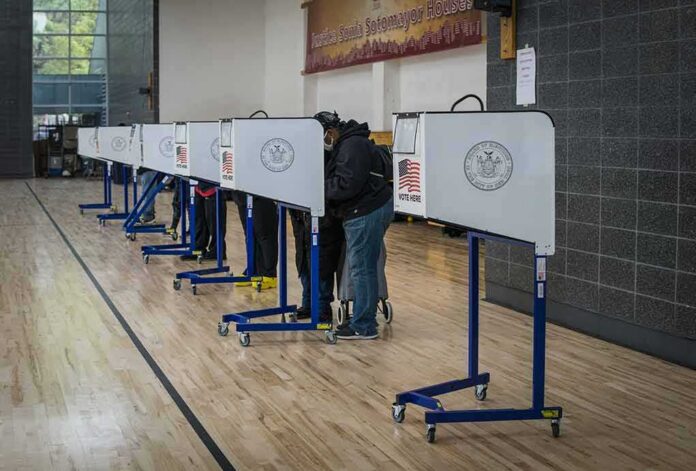
Turnout is the fulcrum of the fight. One line of analysis stresses that in a city of around nine million, the share of residents who voted for Mamdani sits well below a fifth, which blunts the “sweeping mandate” narrative [5]. That view is common in big-city elections, where off-year cycles depress participation. A practical takeaway stands out: whoever mobilizes their base best wins the day. Mamdani’s team did that better than anyone else in 2025.
Youth Surge Flipped the Script on Old Assumptions
Voters under 30 backed Mamdani by 75%, with analysts increasing their turnout estimate from 19% to 28% once late data came in [6]. That shift matters. It shows energy can materialize if a campaign speaks to cost of living, transit, and safety in daily-life terms. Conservative readers should clock the lesson: when younger voters feel seen on wages and housing, they show up. Dismissing them as flaky risks missing where future majorities will form [6].
That bloc did not move alone. Ranked-choice voting rewarded broad acceptability, not just passion. Mamdani improved in later counting rounds in the primary, which means he won second and third choices from voters who did not start with him [4]. That is coalition behavior, not factional capture. It also warns would-be opponents: negative-only strategies backfire in a ranked-choice environment because alienating second-choice voters costs you real votes [4].
Coattails: From City Hall To Congress
Allies of the new mayor turned momentum into primary wins. Brad Lander was projected to defeat incumbent Dan Goldman in New York’s 10th Congressional District, a marquee result that showed the left can beat well-known moderates when the map fits the message [11]. Claire Valdez claimed a House primary, and Darializa Avila Chevalier built a narrow edge over a sitting member, underscoring the pattern [13]. These are not message-board victories; they change committee seats and negotiating coalitions in Washington [11][13].
Chris Rabb’s win in Pennsylvania added a data point for a broader wave, though each state has its own math. The through line is not slogans but organizing: door knocks, small-dollar fundraising, and tight targeting. Crowd size does not pass bills, but controlled precinct work swings primaries. That is what we just witnessed across New York districts aligned with the mayor’s brand.
The Mandate Question, Policy Pivots, and What Comes Next
Critics say the victory is thinner than the headlines suggest because the final vote equals a small slice of the full city, and they challenge consistency on policing and Israel policy, where statements evolved over the last cycle [5]. That charge lands because words matter. The response from Mamdani’s side is simple: winning means persuading a live electorate, then governing for everyone. On the facts, he won; on turnout, his team still has room to grow the tent [5].
Darializa Avila Chevalier Wins NY-13 Democratic Primary
Darializa Avila Chevalier, a 32-year-old Democratic socialist, community organizer, and PhD student at CUNY (Columbia University graduate), defeated five-term incumbent Rep. Adriano Espaillat in the June 23, 2026,… pic.twitter.com/BTKRyE6v48
— News Picks Daily (@NewsPicksDaily) June 24, 2026
The decisive test now moves from primaries to performance. City residents will judge results: safer streets, faster commutes, lower rents, cleaner blocks. Business owners will watch tax and permit signals closely. Parents will track school gains. If delivery matches promise, the coattails get longer. If not, the next primary cuts them short. Common sense says the winning formula blends bold goals with steady management. New York just hired that experiment. The clock started the day he took office.
Sources:
[1] YouTube – Mamdani-backed candidates sweep Democratic primaries in New York
[3] YouTube – Zohran Mamdani wins New York City mayoral election | BBC News
[4] Web – 2025 New York City mayoral election – Wikipedia
[5] Web – Ranked choice voting in New York City’s 2025 primaries – FairVote
[6] Web – Zohran Mamdani wins New York City mayoral election – BBC
[11] Web – Democratic Socialists of America – Wikipedia
[13] Web – Democratic Socialists of America – Wikipedia
© horizonpost.com 2026. All rights reserved.