

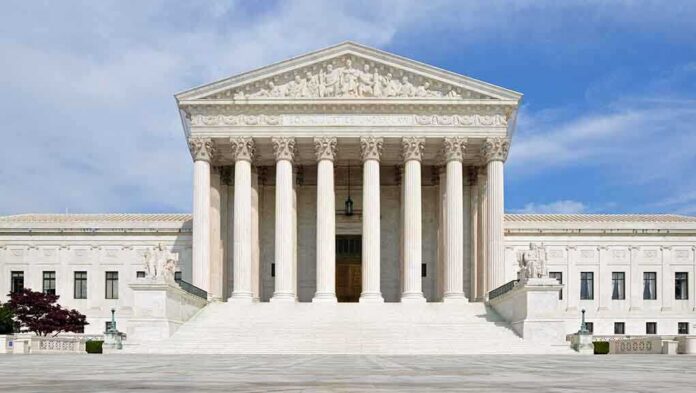
horizonpost.com — Gunfire near a Supreme Court justice’s home is the kind of headline that freezes your spine, but the real story here is how fast a vague late-night scare can harden into a political “assassination attempt” narrative with almost no hard facts behind it.
Story Snapshot
- The public record so far does not show proof that a justice was targeted at home.
- Most available documents actually deal with a separate Montana shooting case and emergency home entry rules.
- A different justice did recently have a clearly documented carjacking attempt outside her residence.
- Early media framing and social media outrage can outrun the evidence and shape what people “know” forever.
How a Late-Night Gunfire Call Became a Political Rorschach Test
Police rushing to a Supreme Court justice’s Washington, D.C., home after a report of gunfire sounds like the opening scene of a national crisis. One report describes officers responding to calls of shots fired, coordinating with the justice’s security detail, and then determining the incident was a hoax call rather than an active attack.[6] That is a far cry from a confirmed assassination attempt, yet the emotional punch of “gunfire at a justice’s home” encourages people to fill in the blanks with their own fears and politics.
Government officials who will be found guilty of helping Senator Ronald "Bato" Dela Rosa escape the Senate following the May 13 shooting at the legislative chamber will be barred from holding public office, former Supreme Court senior associate justice Antonio Carpio said Friday.…
— GMA News (@gmanews) May 22, 2026
The research set you provided confirms how thin the public paper trail is on this particular D.C. incident. There is no incident report, no suspect name, no ballistics data, no warrant affidavit, no confirmed motive tying any shots to the justice personally. Instead, most of the formal legal material concerns a different story: a Montana welfare check gone wrong that ended with officers entering a home without a warrant and shooting a man inside, now at the center of a Supreme Court case about emergency-aid doctrine.[1]
What the Record Shows – And What It Does Not
The Montana case, known as Case v. Montana, lays out the legal standard for when officers may cross a threshold without a warrant if they believe someone inside is seriously injured or in imminent danger.[1] That dispute turns on whether police had an “objectively reasonable basis” to think a shooting victim needed aid inside the home. It says nothing about a Supreme Court justice’s residence in Washington, D.C., no mention of carjacking, and no hint of a targeted political attack on any justice.
Several news summaries in your research discuss that Montana decision and describe the Supreme Court tightening or clarifying when law enforcement may enter homes without warrants in emergency circumstances.[2][3][5][6] These are big constitutional stakes that conservatives and civil libertarians care about: the line between reasonable police action and unaccountable home invasion. But they are not evidence of a gunman stalking a justice’s front lawn. Treating them as if they verify that kind of plot confuses legal doctrine with on-the-ground fact.
The Sotomayor Carjacking Attempt Shows What Real Evidence Looks Like
To see what a documented event actually looks like, examine the recent attempted carjacking outside Justice Sonia Sotomayor’s residence. A deputy United States Marshal assigned to protect Supreme Court justices was sitting in an unmarked vehicle near her D.C. home when an 18‑year‑old allegedly approached, pointed a handgun at him, and tried to steal the car.[1] Both marshals fired; the suspect was hit and later charged with armed carjacking and multiple firearm offenses.[1][2]
In that case, the Metropolitan Police Department identified the suspect by name, listed specific charges, and publicly stated that the attempted carjacking appeared random, with no indication the young man even knew he was targeting a justice’s security detail.[1][2] That is how real evidence works: you get suspects, charges, and a narrative that can be tested in court. By contrast, the D.C. gunfire scare at another justice’s home currently has none of that on the record. From a common-sense, evidence-first conservative standpoint, elevating the hoax-call incident to “attempted assassination” territory without hard proof risks weaponizing fear instead of clarifying facts.
Why the Gap Between Narrative and Evidence Keeps Growing
The broader pattern you flagged is crucial. In high-profile incidents—especially anything touching the Supreme Court—there is a predictable lag between the first wave of media narrative and the slower, dryer evidentiary record. Research in your materials shows how quickly unrelated Supreme Court gun cases and police shooting disputes get pulled into the conversation whenever violence and justices are mentioned together.[1][5] That mix-and-match coverage creates an evidentiary fog where citizens are left to guess what really happened at a specific address on a specific night.
American conservative values emphasize both law and order and the presumption of innocence, which here cuts in two directions. On one hand, credible threats against justices are real; an armed individual literally traveled to Justice Brett Kavanaugh’s home and told police he intended to kill a “specific United States Supreme Court justice” over abortion and gun cases, later pleading guilty to attempted murder.[4] On the other hand, not every noise, hoax call, or nearby crime automatically becomes another Kavanaugh‑level plot. Treating every unverified scare as proof of organized political terrorism dilutes the seriousness of the genuine cases and invites government overreach in response.
How to Think About These Incidents Without Taking the Bait
The responsible path forward is boring, which is why few outlets take it: demand actual documents. Ask for the Metropolitan Police Department incident report, the 911 audio, the detective’s first narrative, and any charging documents. Compare that to the standard that the Supreme Court is wrestling with in the Montana case, where justices must decide exactly what qualifies as an “objectively reasonable basis” for warrantless entry.[1] Then judge police action—and media framing—against those facts, not against click‑driven speculation.
Citizens over 40 have seen this pattern repeat: from supposed “shots fired” that turn out to be fireworks, to “bombshell” rulings that are narrower than the chyrons promised. The D.C. gunfire scare at a justice’s home sits in that same gray zone for now. The smart play is to hold two ideas at once: Supreme Court justices are legitimate targets for extremists, and not every siren near their homes proves it. Evidence, not adrenaline, should make the call.
Sources:
[1] Web – Report: Police Rush to Supreme Court Justice’s Home After Gunfire …
[2] Web – CASE v. MONTANA | Supreme Court – Law.Cornell.Edu
[3] Web – Shooting prompts Supreme Court to tighten emergency warrantless …
[4] Web – Shooting prompts Supreme Court to tighten emergency warrantless …
[5] Web – Justices Reject “Moment of Threat” Rule in Police Shooting Case
[6] Web – Court hears arguments on when police may enter a home without a …
© horizonpost.com 2026. All rights reserved.