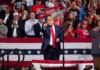

The loudest political message of the weekend may have been the moment everyone argued about what they heard.
Story Snapshot
- President Donald Trump showed up at UFC 327 in Miami as online clips debated whether the crowd booed, cheered, or stayed oddly quiet.
- The “music turned up to hide it” claim spread fast, but the available video audio doesn’t conclusively prove booing.
- At nearly the same time, Vice President JD Vance announced U.S.–Iran talks in Islamabad collapsed after about 21 hours.
- The diplomatic breakdown centered on U.S. demands for nuclear limits and Iran’s refusal to accept the terms.
UFC 327 in Miami became a political Rorschach test in real time
President Trump’s entrance at UFC 327 at Miami’s Kaseya Center landed like a match strike in dry grass: instant claims, instant counterclaims, instant certainty from people who weren’t there. Some viral clips framed the moment as booing masked by loud music; other observers described it as a mixed or unusually muted reception. That uncertainty matters, because a noisy arena can manufacture “proof” for whatever storyline a viewer already wants to believe.
The smarter question isn’t “Did they boo?” but “Why does everybody need it to be booing or cheering?” UFC crowds historically tilt pro-Trump, and that history primes supporters to hear applause and critics to hear backlash. Sound in a packed venue is messy: chants overlap, microphones distort, and broadcast mixes emphasize walkout music. Social media rewards the most dramatic interpretation, not the most accurate one.
Islamabad talks collapsed after 21 hours, and the timing fueled the optics
While UFC clips ricocheted online, Vance delivered the substantive news from Islamabad: the U.S.–Iran peace talks had failed after roughly 21 hours. Reports described Iran rejecting U.S. terms on nuclear limits after a temporary ceasefire set the stage for negotiations. Vance’s posture suggested the White House wanted to project firmness, arguing the outcome hurt Iran more than the United States if Tehran refused the “final” offer.
Talks like these don’t usually die from one sentence; they die from incompatible bottom lines. The U.S. wanted clear limits and commitments; Iran resisted what it framed as unreasonable demands. That standoff has a familiar shape for anyone who remembers the long shadow of Trump’s 2018 withdrawal from the Obama-era JCPOA. When Washington exits a framework and doesn’t replace it with an enforceable alternative, every later negotiation starts with less trust and fewer off-ramps.
Trump’s “I don’t care” posture plays well at home until it doesn’t
Reports also highlighted Trump’s comments earlier on April 11 dismissing the stakes of a deal, paired with his evening appearance at a high-energy sporting event. Critics pounced on the contrast: cage fights at home, diplomacy abroad, with the implication that the administration treated foreign policy like background noise. Supporters will argue a president can delegate negotiations and still maintain a public schedule. Common sense says both can be true, but optics still shape credibility.
Credibility matters in negotiations because it signals resolve and clarity. Conservative voters often respect a leader who sets red lines and refuses to beg for agreement, especially with an adversary like Iran. The risk comes when “toughness” sounds like indifference. A message of “we’re fine either way” can reassure domestic audiences, but it can also reduce leverage overseas by implying the U.S. lacks urgency to lock in verifiable limits before the next escalation.
The booing debate distracts from the harder reality: leverage is expensive
The viral UFC moment is compelling because it feels measurable: cheers equal strength, boos equal weakness. Real leverage looks uglier. It requires enforceable terms, inspection regimes, consequences that allies will actually support, and a credible path for sanctions relief or pressure. If the White House truly offered a “final and best” proposal, the next move becomes a test of endurance. Iran can wait out news cycles; Americans can, too, but only if leaders level with them about the costs.
The bigger unresolved loop isn’t whether a Miami crowd sounded enthusiastic. It’s whether Washington can sustain “maximum pressure” without a durable diplomatic architecture. Markets react to Middle East instability, service members pay the price when deterrence fails, and voters eventually notice when dramatic posturing produces the same stalling pattern. If talks stay frozen, every side starts recalculating what comes after the ceasefire, and miscalculation is where wars begin.
What to watch next: verification, not volume
Expect two parallel battles. The first is the easy one: competing edits of the UFC entrance, each engineered to “prove” a moral verdict. The second is the consequential one: whether Iran re-engages or doubles down, and whether the U.S. can keep allies aligned behind terms strict enough to matter. Conservatives should demand seriousness over theater: clear objectives, transparent benchmarks, and accountability for results, not just vibes from an arena sound mix.
https://twitter.com/BonnieJLemoyne/status/2043471177071345820
The weekend’s lesson is blunt: crowds make noise, but nations make choices. Even if the Miami audio never settles into a definitive answer, the Islamabad failure already did. The administration now owns the next step, whether that means reopening channels, tightening pressure, or admitting the current approach can’t produce a verifiable deal. That decision will outlast any chant that may or may not have happened.
Sources:
Very unserious: Donald Trump booed at UFC event as JD Vance fails to secure Iran peace deal
Donald Trump Struts Around UFC Cage Match as Peace Talks Fail 8,000 Miles Away
Donald Trump goes to UFC match while JD Vance says Iran peace talks have failed