

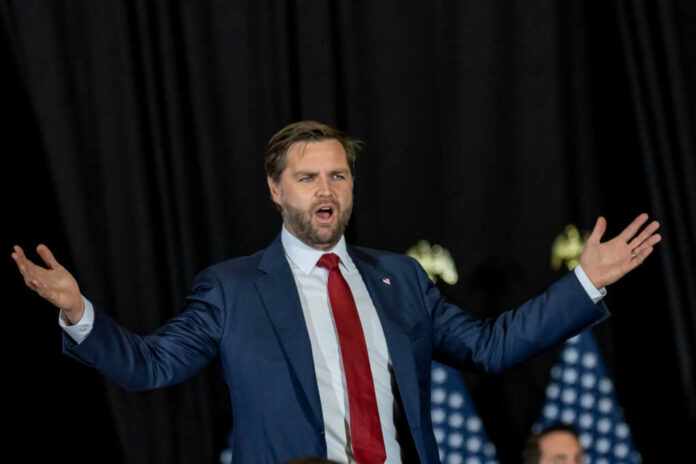
The crowd came to hear a speech, but one shouted line forced Vice President JD Vance to show how he handles heat.
Story Snapshot
- Vice President JD Vance was heckled during a Turning Point USA event at the University of Georgia.
- The interruption featured shouts about Gaza and accusations of killing children.
- Vance answered the outburst from the stage and continued his remarks.
- The exchange fits a common campus-speech pattern: protest crosses paths with invited speakers.
What Happened In Athens, Georgia
Vice President JD Vance spoke at a Turning Point USA event at the University of Georgia on Tuesday, April 14, 2026. About ten minutes into his remarks, a person in the audience shouted, “Jesus Christ does not support genocide!” Another voice yelled, “You’re killing children! You’re bombing children!” The room grew tense, and phones went up. Vance paused, addressed the criticism, and defended the administration’s approach before moving on with the program.
Video clips from the venue show the disruption and Vance’s response in real time. National outlets carried the footage and described the exchange nearly the same way, including the shouted lines and the timing within the speech. One broadcast segment reported that the disruptive attendee was later removed from the venue. The reports tied the protest to anger over the war in Gaza and broader Middle East policy, which has stirred campuses across the country this year.
Vance’s Reply And Why It Landed
Vance did not duck the charge. He repeated the heckler’s line about Jesus, then argued that moral claims cut both ways. He said the administration weighs civilian harm and pushes humanitarian relief, even as it backs the right of allies to defend themselves. That framing put him on common ground for many voters: empathy for civilians and clarity about security. It also showed a political instinct conservatives value—meet the claim head-on, hold your ground, and finish the speech.
The decisive move mattered as much as the words. Crowds watch for tells. If a leader flinches, the room shifts. If a leader stands firm, the room often settles. In Athens, the event resumed. That ending placed this moment on the “spirited but not shut down” side of the campus spectrum. The speaker spoke, the protester protested, and the audience heard both before the lecture continued. That is not a collapse of debate; that is debate in full view.
Why This Keeps Happening On Campus
Universities now sit at the crossroads of national fights. Outside conflicts, like the Israel–Gaza war, become symbols in lecture halls and student centers. When a high-profile conservative arrives, some students see a rare chance to confront policy, not just ideas. Legal scholars and civil liberties groups draw a line here: brief, pointed counterspeech is protected, but sustained disruption that drowns out a speaker becomes a “heckler’s veto,” which officials should prevent to protect everyone’s rights.
Guess TPUSA was set-up for/with Trump and JD Vance next; all for the billionaires and zionists Eretz Israelis … After all the Trump team rectruited both #CharlieKirk and #ErikaKirk Religion hijacked for votes, once again
— Karma'geddon • αντιδιαφθορά • Anti Corruption (@AndySanTH) September 11, 2026
That line matters more than ever. The modern norm is not censorship by decree; it is noise that makes speech impossible. Groups across the spectrum warn against turning disruption into a tool to erase events. They argue that officials must act fast to keep order so that protest and speech can coexist. At Athens, the exchange was sharp but short. The event continued. That outcome tracks what many campus guidelines call the best practice: let protest speak, then let the program proceed.
The Political Stakes For Both Sides
Democrats often frame these moments as moral witness. Republicans often frame them as proof that debate is under threat. Both sides know the clip will live online far longer than the speech itself. For conservatives, Vance’s calm reply signals steadiness under pressure. For progressives, the shouted line distills outrage in seven words. Each camp leaves with a shareable story and a feeling that it fought for its values. The question is which story persuades the middle.
Most voters want two things at once: safety and decency. They back strong defense, and they want fewer civilian deaths. They cheer leaders who can say both without wobbling. That is why the Athens moment matters. It tested tone, not only policy. A clear answer delivered in the heat tells more about a leader than a polished line at a rally. The room saw it live. Millions more saw it on their phones shortly after.
How To Keep These Events From Melting Down
Event hosts should set and enforce crisp rules: short protests allowed, drown-outs stopped. Universities should train staff to step in fast so the standard is even and fair. Speakers should plan for sharp audience pushback and prepare a brief, humane answer that shows command. Audiences should get what they came for—a chance to hear, a chance to challenge, and a chance to leave with their minds sharper than when they sat down. That is how a campus stays a campus.
The Athens event shows the workable balance. A loud charge met a direct reply. The speech went on. Voters saw a test of leadership in plain sight. They also saw a guardrail that still holds: protest and speech can share a stage when adults in the room keep both within bounds. Expect more tests like this as the campaign trail runs through more campuses—and more phones—this year.
Sources:
redstate.com, abcnews.com, nytimes.com, washingtonexaminer.com, facebook.com, instagram.com
© horizonpost.com 2026. All rights reserved.