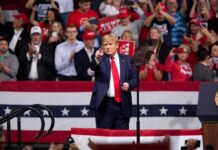

A five-day US military campaign against Iran has sent oil prices soaring beyond 10%, with vessel traffic through the Strait of Hormuz grinding to a halt as President Trump declares operations are ahead of schedule while consumer energy bills threaten to spike toward triple digits.
Story Snapshot
- US oil jumped over 10% to $71.23 per barrel as military strikes hit 2,000 Iranian targets in five days with complete air superiority claimed
- Shipping through the Strait of Hormuz, carrying 20% of global crude supplies, has ceased amid Iranian retaliation threats including an alleged US tanker strike
- Trump projects a 4-5 week war duration but experts warn of prolonged conflict risking triple-digit oil and inflation spikes
- White House mitigation team led by Energy Secretary Wright and Treasury Secretary Bessent scrambles to contain economic fallout from potential 3.2 million barrel per day Iranian output loss
The Hormuz Chokepoint Crisis Emerges
The Strait of Hormuz has become the critical pressure point in a conflict that began erupting in early March 2026 after weeks of escalating tensions. This narrow waterway, through which one-fifth of the world’s crude oil passes daily, now sits silent as military operations rage overhead. US naval deployments in February signaled the coming storm, but the actual eruption of hostilities on March 2 transformed market anxieties into immediate supply disruptions. Iranian state media claims a strike on a US oil tanker in the northern Persian Gulf remains unverified, yet the threat alone has paralyzed shipping operations and sent crude prices climbing from the mid-60s to over $71 per barrel in days.
US oil price soars over 10% after Trump demand on Iran
— CGTN America (@cgtnamerica) March 6, 2026
Trump’s confidence stands in stark contrast to the market’s jitters. Speaking on day five of operations, the president emphasized US control of Iranian airspace and pointed to 2,000 targets eliminated, describing progress as ahead of projections. The administration’s energy independence narrative, bolstered by a 600,000 barrel per day production increase since inauguration, attempts to reassure Americans that domestic output at 13.6 million barrels daily provides a buffer. Yet analysts from S&P Global and think tanks including CSIS note a glaring contradiction: the very triple-digit oil prices this conflict threatens would undermine Trump’s political vulnerability to inflation and consumer anger at the pump.
Strategic Petroleum Reserve and Mitigation Plans
Secretary of State Marco Rubio announced a price mitigation program on March 2, placing Energy Secretary Chris Wright and Treasury Secretary Scott Bessent at the helm of emergency response efforts. The Strategic Petroleum Reserve looms as the obvious tool, though the Department of Energy has not responded to inquiries about deployment plans. The challenge is formidable: Iran’s potential 3.2 million barrel per day outage, if sustained through regime change or prolonged conflict, would create chronic supply shortfalls no reserve release could permanently solve. Historical precedents offer limited comfort. The 2019 Abqaiq attack and Soleimani assassination caused brief spikes but no sustained Hormuz blockade; the Russia-Ukraine war disrupted other flows but left this critical chokepoint untouched until now.
The economic ripple effects extend far beyond fuel pumps. Big Oil companies, facing a gloomy 2026 outlook before hostilities erupted, now see windfall profits as prices climb. US drillers benefit from the price surge even as rig counts remain down 41 year-over-year, reflecting broader industry caution about demand growth that was already slowing pre-conflict. China, the world’s top oil importer, has begun conserving fuel amid supply uncertainty, adding another layer of demand volatility to an already chaotic market. Consumers face the immediate pain: soaring energy bills that compound existing affordability pressures and threaten to reignite inflation just as economic managers thought they had it contained.
Military Timeline and Operational Assessment
The conflict timeline reveals a rapid escalation from diplomatic posturing to full combat operations. Mid-January protests in Iran, brutally suppressed by the regime, first nudged oil prices upward in an otherwise oversupplied market. February saw Trump signaling US naval deployments to the Gulf, pushing prices into the mid-to-upper $60s per barrel. On February 28, the president touted energy production gains at the Port of Corpus Christi, projecting confidence even as military assets moved into position. March 2 marked the formal outbreak of hostilities, with NYMEX April crude settling at $71.23, up $4.21 in a single session as vessel traffic halted and Trump projected a 4-5 week campaign, possibly longer.
Israel’s role as co-combatant adds strategic depth to US operations but also widens the conflict’s regional implications. The Iranian regime, led by clerics and naval commanders who control the Hormuz leverage, faces existential pressure to retaliate asymmetrically. Their claimed strike on a US tanker, if confirmed, signals willingness to target energy infrastructure directly rather than merely threaten its passage. Trump’s air superiority claims suggest conventional military dominance, yet analysts at the Council on Foreign Relations warn that regime change, the likely objective, remains improbable without descending into chaos that could destabilize the entire region and prolong supply disruptions indefinitely.
Expert Analysis and Price Forecasts
Energy analysts split sharply on duration versus successful mitigation. S&P Global warns that without a clear end in sight, triple-digit oil becomes increasingly probable. ClearView Energy Partners assesses escalation as more likely than stand-down, with regime change scenarios carrying extreme risks of prolonged outages. The Center for Strategic and International Studies highlights the discrepancy between market fundamentals pointing toward $100-plus oil and Trump’s documented sensitivity to consumer price pressures. The Middle East Institute calculates the negative inflation shock from a full 3.2 million barrel per day Iranian outage, while OilChange.org critiques Big Oil’s profiteering amid human costs, arguing windfall gains deepen the affordability crisis for ordinary Americans already stretched thin by prior inflation waves.
BREAKING – US oil price soars over 10% after Trump demand on Iran https://t.co/9KZ41pSHP5 pic.twitter.com/QtbdmS0Czr
— Insider Paper (@TheInsiderPaper) March 6, 2026
The administration walks a tightrope between projecting military success and managing economic fallout. Trump’s 4-5 week projection offers a contained timeframe, yet his own hedging with “possibly far longer” reveals underlying uncertainty. The power dynamics favor US air and production capacity against Iran’s Hormuz chokepoint control, but asymmetric warfare rarely follows neat timelines. For consumers, the immediate reality is clear: energy costs are spiking, inflation threatens to return, and no amount of Strategic Petroleum Reserve releases can substitute for the 20% of global crude flows now sitting idle in the Persian Gulf. The coming weeks will test whether military optimism or market pessimism proves correct, with American wallets hanging in the balance.
Sources:
Trump says war with Iran to last four to five weeks as oil market weighs impacts – S&P Global