

A broken police officer’s back turns a chant into a crime scene, and the line between protest and prosecution snaps with it.
Story Snapshot
- Peaceful protest ends where violence starts: injury turns speech into a charge.
- Police report officers hurt by rocks and clashes at multiple protests [2][3].
- Court systems jail perpetrators when violence crosses the legal line [1].
- Proof still matters: causation, intent, and identity drive outcomes.
Violence Ends Protest Protections When Officers Are Hurt
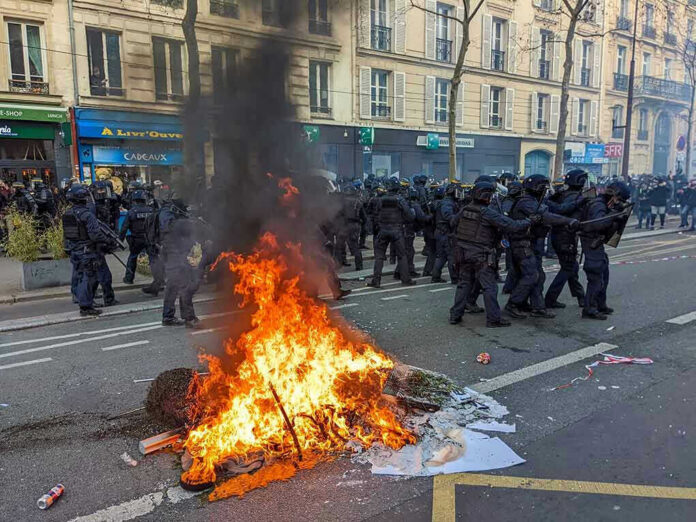
Police across cities have logged injuries during protest flashpoints. In Austin, officers said protesters threw large rocks, injuring three officers. A fourth officer was hurt while making an arrest and was spat on. Police arrested 13 people and listed charges like riot, resisting arrest, interference with public duties, and harassment of a public servant [2]. In Los Angeles, officials declared an unlawful assembly after officers were struck. Seven officers were reported injured, and crime reports included assault with a deadly weapon [3].
These reports show a pattern that repeats under many banners and hashtags. A crowd gathers. A few people cross the line. Officers get hit with objects or during arrests. The moment injuries appear, speech protections give way to criminal law. Courts do jail people for serious protest-linked assaults, as seen in other politically charged cases where attackers faced time behind bars for violent acts, even if the cause they claimed was political [1].
Why A Broken Back Changes The Case Entirely
Injury severity is not a talking point; it sets the charge and the sentence. A broken back signals high force and real risk to life and work. Juries listen when the medical record is clear. Prosecutors weigh intent, identity, and causation. Did the act cause the injury? Was it aimed at the officer? Do videos and witnesses match? Those answers separate lawful protest from felony assault, and they decide whether someone goes home or goes to jail.
Claiming “just a protest” falls apart when facts show thrown objects, direct strikes, or force during an arrest. The Austin charges—riot, resisting arrest, interference, harassment—map to conduct that blocks duties and harms people, not to speech [2]. The Los Angeles data point—officers struck, injuries logged, and assault with a deadly weapon reports—reinforces that line [3]. When police identify a suspect and link the act to the injury with video or witnesses, the courtroom tends to follow the harm.
The Evidence That Sways A Courtroom
Three things decide these cases: clear video, tight timelines, and medical proof. Body camera footage and fixed cameras show distance, force, and the throw or shove. Time stamps link the act to the injury event. Emergency room notes, imaging, and surgeon reports tie damage to impact. When those pieces align, a judge can explain jail time in plain terms: a person chose force, an officer got hurt, and the law protects public safety above street theater.
Weak cases crumble where identification is fuzzy, where crowd motion masks the cause, or where injury claims outrun proof. That is why a good process matters. Defense teams probe whether contact was accidental, whether someone else threw the object, and whether the medical injury matched the alleged force. Prosecutors answer with synced video, witness statements, and the medical record. Common sense says protect free speech and punish violence. American conservative values say order, duty, and justice can and must coexist.
Sources:
[1] Web – It’s ’Gut-Wrenching’ That Thugs Who Broke Police Officer’s Back in …
[2] YouTube – Indonesia acid attack: Four military officers jailed for attack on …
[3] Web – 4 officers injured, 13 people arrested during ICE protests in Austin
© horizonpost.com 2026. All rights reserved.