

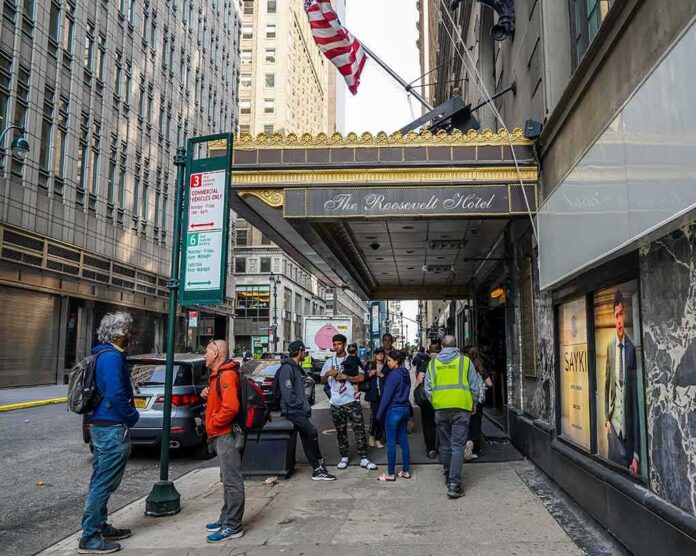
A single wedding at Madison Square Garden turned a prime New York holiday rush into a no-sale zone for bars steps away from the door.
Story Snapshot
- New York City Police closed key blocks around Madison Square Garden for the Swift–Kelce wedding.
- Nearby bar owners say the closures cut sales and tips, with one pegging losses near 50 percent.
- Media praise for the couple’s charity gifts blunted sympathy for local shops, fueling online backlash.
- Proof of “thousands lost” is thin without point-of-sale records or audits, which courts often demand.
Police-Ordered Closures Boxed Out Foot Traffic
The New York City Police Department published a memo and maps closing Seventh Avenue between West 30th and West 34th Streets and other access points around Madison Square Garden. The agency cited security for a large, private, two-day celebration with managed access zones and heavy staffing. That grid is the oxygen for nearby bars. Shut the curb and corner, and the impulse beer, the pregame round, and the bartenders’ rent follow it out the door.
Reporters on the scene heard the same story from multiple owners: the doors stayed open, but the customers did not come. One bar manager across from the arena said the holiday weekend haul dropped by about half. Another named owner, Michael O’Brien, said closures scared off walk-ins and regulars. Others warned of thinner shifts and smaller tip pools as staff stood idle by the taps. That pattern fits what any street merchant knows: no flow, no cash.
The “Thousands Lost” Claim Needs Hard Numbers
Claims of thousands in losses draw clicks but melt in court without receipts. No report cited point-of-sale exports, bank deposits, or a clean year-over-year ledger to back the 50 percent figure. Heat, a July Fourth lull, or staffing changes can also drag sales. An honest before-and-after pull, or a “same weekend last year” yardstick, gives the claim legs. New York disputes over business interruption often stall without that proof, and insurers lean on tight policy language to deny payouts.
A cautious owner would line up three exhibits: certified sales for the holiday weekend this year, the same weekend last year, and a control weekend with no closures. A simple chart shows whether the drop started with the barricades or something else. That is not nitpicking; it is how judges and adjusters think. Reasonable certainty wins. Vibes and viral clips do not. Conservative common sense says prove it, then demand it.
Public Safety Versus Small-Business Survival
The New York City Police Department’s job is safety first, and the memo framed the closures as necessary for a thousand high-profile guests. That point stands on solid ground. Yet the policy tradeoff is real on the sidewalk. When the city blocks core arteries, the city should also plan relief valves for the shops it chokes off. That could mean limited delivery windows, pedestrian pass-throughs to storefronts, or rapid, posted timelines so owners can cut shifts, manage orders, and avoid waste.
Local NYC Bar Owner Blasts Taylor Swift and Travis Kelce Over Wedding Street Closures Details: https://t.co/9oW2vvGZCX pic.twitter.com/T3nfx9lEGx
— Complex (@Complex) July 3, 2026
Coverage that spotlights the couple’s big gifts while brushing past nearby losses misses the street-level math. A million dollars to a food charity helps the city at large. A dead Friday night can sink a bartender’s rent. These two things can be true at once. The fair fix is not outrage at celebrities. It is a city playbook that balances safety with commerce, and a clean path for owners to document harm and seek relief when closures are extraordinary and avoidable.
What Owners Should Do Next
Owners should export hourly sales for the week before, the week of, and the same weeks last year. Note staffing, weather, and delivery blocks. Mark the exact hours of police closures from public advisories. Prepare a short sworn statement that ties the traffic freeze to the sales dip, then share it with the local precinct council and the council member’s office. File a civil authority inquiry with the insurer even if payment is unlikely, because the denial letter can still help future policy talks.
Trade groups should push for a standard “event impact” protocol: early notice windows, storefront access corridors, and a simple claim form for extreme cases. That is not anti-safety or anti-celebrity. It is pro-order, pro-neighbor, and pro-work. New York thrives when the arena roars and the corner bar rings the register. The city can protect both if it treats small business as a stakeholder, not collateral damage.
Sources:
washingtontimes.com, reddit.com, yahoo.com, facebook.com, hcamag.com, youtube.com, tribune.com.pk, abc7ny.com, nytimes.com, instagram.com
© horizonpost.com 2026. All rights reserved.