

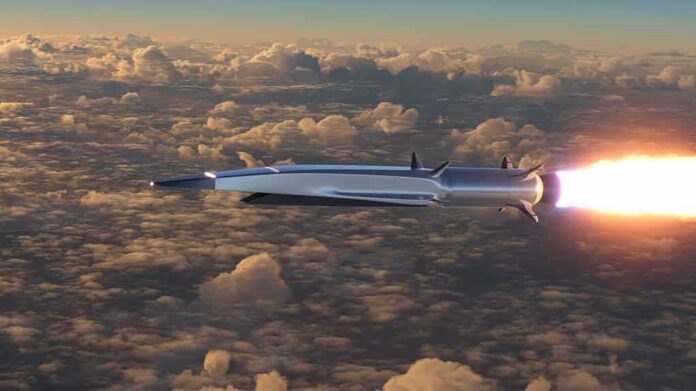
The Air Force just ordered America’s first hypersonic missile into production—and it happened with a $694 million signature.
Story Snapshot
- The Air Force awarded Lockheed Martin a $694 million ARRW production contract.
- The deal marks ARRW’s shift from prototyping and tests to production.
- ARRW is a boost-glide weapon built to fly faster than Mach 5.
- The missile is meant to strike high-value targets from standoff range.
What Moved: A Prototype Became A Production Weapon
The Department of the Air Force said Lockheed Martin won a $694 million contract on September 29, 2026, to produce and field the Air-launched Rapid Response Weapon, known as ARRW. The service publicly announced the award on October 26. The contract moves ARRW out of prototyping and flight tests and into production. The Air Force framed this as a milestone that adds a hypersonic strike option to the force today.
ARRW is designed as a conventional, air-launched, solid-rocket-boosted glide weapon. A bomber releases the missile, the booster fires, and a glide body then races toward the target at hypersonic speed. The stated goal is speed beyond Mach 5 and maneuvering that stretches defenses. The service linked ARRW to hitting time-sensitive, high-value targets from outside the densest air defenses, which is the core promise of standoff hypersonic strike.
Why It Matters: Speed, Reach, And Deterrence
The Air Force said ARRW will help penetrate advanced anti-access and area-denial systems. That claim aligns with the basic physics of boost-glide flight: high speed, unpredictable paths, and compressed timelines for defenders. If fielded at scale, the weapon could hold critical nodes at risk early in a fight. That includes radars, launchers, command hubs, and runway chokepoints that shape the opening hours of a modern air war.
Congress set the table for this step with earlier funding. Reporting notes the program secured $362 million in fiscal 2026 procurement and appeared in the Air Force’s fiscal 2027 production request for $452 million. Those figures signal a long runway for orders if budgets hold. Flight tests have run since 2019, creating the technical base that underpins a production green light now.
The Known Gaps: Quantities And Timelines Stay Classified
The Air Force did not disclose how many missiles this contract covers or when deliveries begin. Officials cited operational security for withholding those details. That choice protects tactics and capacity, but it also blocks outside estimates of unit cost or pace. The public announcement arrived nearly a month after the award. The release did not offer more than general security reasons for the timing.
🇺🇸 Lockheed Martin has been awarded a $694 million contract by the U.S. Department of the Air Force for the production and fielding of the AGM-183A Air-Launched Rapid Response Weapon (ARRW). @LockheedMartin @usairforce
The contract, awarded on Sept. 29, was executed under the… pic.twitter.com/VPA0Rfyh7m
— DefPost (@defpostmedia) October 27, 2026
ARRW’s path was not a straight line. Coverage reminds readers the Air Force considered ending the program without production about three years ago, before changing course. The shift tracks with a broader pattern in defense buys: leaders often treat a production award as momentum, while analysts separate contracting from proven, fielded combat power. That caution is fair, but does not change the bottom line here—ARRW has entered production under an awarded deal.
How ARRW Fits The Air War Playbook
U.S. strategy hinges on breaking open defended airspace fast. Hypersonic standoff strike offers a way to hit key systems before they can scatter or shoot back. ARRW aims to give bomber crews that tool. From a conservative, common-sense view, buying real missiles moves deterrence faster than speeches do. Adversaries watch what we deploy, not what we brief. Production places steel on the ramp and pressure on those who would test American airpower.
Test history shows a mixed start, followed by progress. Government Accountability Office reporting described a successful late-2022 flight with limited data and a failed early-2023 test tied to shroud and heat protection. Additional flights followed to inform decisions. That arc reflects how cutting-edge weapons mature: build, test hard, fix, test again, then buy if the math and results line up.
What To Watch Next: Budget, Integration, And Fielding
Budget stability will shape how fast ARRW moves from factory to flight line. Reports said the fiscal 2027 request was stalled while the Pentagon operated under a continuing resolution at fiscal 2026 levels. That setup can slow new starts and options. Integration on bombers like the B-52 and operational acceptance by units will mark the next real-world milestones to track after the contract signature.
Delivery records, unit equipment, and training events will signal when crews can load and launch ARRW for real. Public release of test evaluations could further validate speed, maneuver, reliability, and terminal effects. For now, the fact to bank: the United States has ordered its first hypersonic missile into production, with a contract that commits money, parts, and people to building a new arrow for the quiver.
Sources:
realcleardefense.com, airandspaceforces.com, twz.com, defence-blog.com, forbes.com
© horizonpost.com 2026. All rights reserved.