

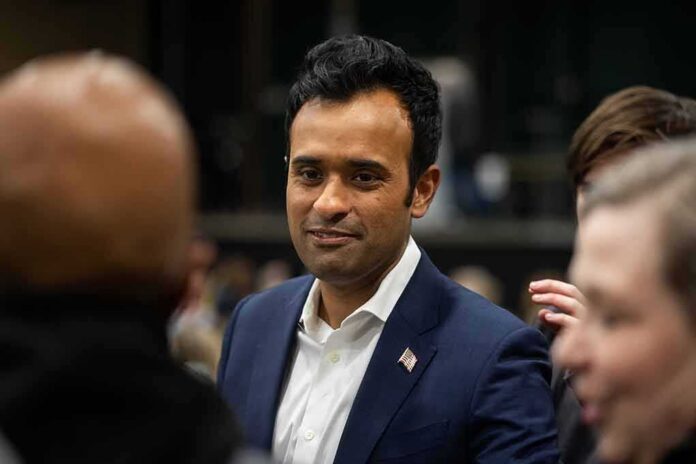
An Ohio governor’s race turned on a mother’s on-camera attack—and a campaign that owned it.
Story Snapshot
- Vivek Ramaswamy’s campaign confirmed it produced and will air the ad featuring Amy Acton’s estranged mother.
- The mother accuses Acton of lying about her past and warns voters on camera.
- The campaign plans a $4 million statewide buy to run the spot across Ohio.
- Backlash came fast from both parties, while Acton’s brother publicly defended her.
What the ad says and why the campaign says it matters
The advertisement features Donna Arthur, Amy Acton’s estranged mother, looking into the camera and calling her daughter a liar. She urges voters not to elect Acton as governor. The Ramaswamy campaign confirmed the spot as its own and defended the thrust: character and truthfulness. A spokesperson framed Acton as a “serial fabulist,” saying voters must hear from “people who know” her. The campaign’s defense hinges on credibility, not policy, and it invites voters to treat biography as evidence.
The message is stark and personal, which is why it lands with force in 15 seconds. Character attacks often do. But character claims live or die on proof. The campaign did not release records to back the “serial fabulist” label. It presented no clear example of a verified lie. The mother’s claim also faces a reach problem because reporting describes a decades-long estrangement that limits her direct knowledge of Acton’s later life.
How the spot moved from rumor to owned message
Early coverage described the video moving online with unclear attribution. That is common in modern politics, where content travels faster than disclaimers. The Ramaswamy team first declined to confirm responsibility. Then it embraced the ad, said it would air on television and streaming, and announced a major statewide buy. That shift created a second storyline about transparency. Owning the ad gave it reach and also increased the cost if voters viewed it as unfair.
The $4 million spend signals confidence that the spot helps more than it hurts. That is a high-stakes bet. Research shows negative ads can backfire, especially when they lean on moral shock without clear proof. Voters often punish tactics that feel exploitative. The campaign appears to be gambling that doubts about Acton’s story will stick harder than anger over the tactic, and that swing voters will prize “truth telling” over sympathy.
The counterpunch: family pushback and bipartisan scorn
Philip Stearns, Acton’s brother, blasted the ad as a political use of his sister’s childhood trauma. He said their birth mother remained married to the man he named as Acton’s abuser, even after the children were removed from custody. That charge goes to motive. If accurate, it makes the mother a weak witness on the most sensitive facts. Prominent Democrats and some Republicans called the ad shameful and beneath decency, a framing that can harden public opinion fast.
The Ramaswamy-Amy Acton Ad: Despicable and Unwise
In his Campaign for Ohio Governor, Mr. Vivek Ramaswamy ran and is running a social media ad against his opponent, Dr. Amy Acton. The ad featured Dr. Acton's estranged mother calling Dr. Acton a liar and saying that Dr. Acton…
— Lawyered Up (@Lawyeredup1) October 21, 2026
Voters hear two stories: a campaign saying character counts, and a family saying pain got turned into a talking point. American conservatives value truth, due process, and restraint with family wounds. On the evidence shown, the campaign established authorship and intent, not proof of deceit. That gap matters. If you claim a pattern of lying, show the record—dates, quotes, corrections. If you cannot, you risk teaching voters that your main point is outrage, not facts.
Why this fight feels bigger than one race
This ad sits in a trend where personal biography becomes the battlefield. Many modern campaigns shift from policy contrast to stories that paint virtue or vice. These spots spread first on social media, then jump to television. The half-life is short, but the feelings last. Studies of past ad cycles find that attack ads often mix emotion with thin proof. That pattern does not prove this ad false. It does flag a buyer-beware warning for anyone taking political television at face value.
What evidence would settle it
Proof looks like this: contemporaneous records, sworn statements from independent witnesses, and clear examples where Acton’s public claims do not match documents. The campaign could release full interview tapes, scripts, and payment records to show who said what and why. Reporters could pull court files from the late 1970s to clarify custody events. If the brother’s account of homelessness and tent living holds up, the ad’s central charge collapses. If not, voters deserve to see where and how.
Bottom line for voters who hate games
Hold two rules. First, character matters. Second, claims need proof. The Ramaswamy team owned the ad and put real money behind it. That shows resolve but not evidence. The most persuasive path in a governor’s race is still simple: show receipts, show plans, and show respect for lines we do not cross. Voters can reward toughness that is tied to facts—and punish spectacle that is not.
Sources:
mediaite.com, nytimes.com, cnn.com, rollingstone.com, badads.cs.washington.edu
© horizonpost.com 2026. All rights reserved.