
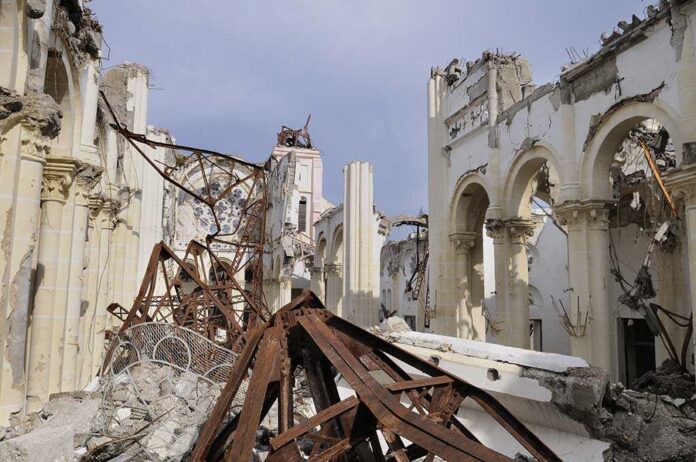
A 140-year-old Catholic landmark in Buffalo went up in flames and was ruled arson, just as plans to turn its grounds into a mosque were stirring fierce debate.
Story Snapshot
- Officials say the latest fire at the former St. Ann’s Church was deliberately set.
- The church complex was already damaged by a massive blaze at its old school building.
- Developers have eyed the site for a Muslim worship center and community facilities.
- Locals now question whether the arson and redevelopment fight are connected.
A historic Catholic church becomes a burned-out crime scene
Buffalo firefighters were called to the former St. Ann’s Church on Emslie Street after flames broke out at the vacant landmark, a roughly 140-year-old Catholic church that had already sat empty for years. Crews arrived around 5:45 in the evening and brought the fire under control, but not before more damage hit a property many residents still see as part of the city’s religious heart. Days later, officials confirmed what many suspected from the start: the fire was arson.
Television coverage made the stakes clear. Reporters described the blaze as the second fire at the St. Ann’s site in a week, and this time the Buffalo Fire Department said someone intentionally started it. A local station later ran a segment with the blunt title: “Fire at former St. Ann’s Church determined to be arson.” That ruling turned a sad scene into an active criminal case, and it poured gasoline on an already heated local argument about the future of the property.
Repeat fires at a troubled, vacant church complex
This wasn’t the first time flames tore through the St. Ann’s grounds. In January, a four-alarm fire gutted the former parish school building, a tall brick structure on the same campus as the old church. More than 100 firefighters battled that overnight blaze, which caused an estimated $600,000 in damage, left the building a roofless shell, and forced the city to declare a collapse zone for safety. That earlier disaster spared the main church, but it left the whole complex scarred and unstable.
City and local reporters described the school building as destroyed and noted that the cause of that January fire had not yet been determined. At the time, officials struggled even to pin down who owned the property, because an investment group that bought the grounds in 2022 with redevelopment plans may have already sold them again. The picture was simple and grim: a once-proud Catholic complex, empty, decaying, burned, and caught between paperwork and politicians.
Plans for a mosque and community center fuel suspicion
The 2022 sale of the former St. Ann’s parish grounds did not just move a deed; it introduced a new vision for the site. Local reporting says the investment group planned to convert the campus into a Muslim worship and gathering place, along with a community center and health care facility. For some, that sounded like fresh life for a dead building. For others, especially traditional Catholics and cultural conservatives, it felt like losing a sacred space to a different faith.
That tension matters when a church burns. Americans have watched landmarks in Europe turn from churches into mosques over centuries. Many see that history as a warning about what happens when Christian institutions decay and civic leaders treat religious heritage as just another parcel on a map. From that angle, arson at a Catholic site up for possible mosque conversion feels less like an isolated crime and more like a symbol of a country drifting from its roots.
Investigators talk about human causes, but not motives
On the technical side, fire officials have been careful. Buffalo Fire Commissioner Daniel Pizarro explained that St. Ann’s was a well-known abandoned building with no electricity or gas service inside. He said that fact led him to believe the fire’s cause was man-made, and he noted crews had been to the property several times since January for squatters and people living inside. At the rear of the structure where the fire started, investigators found a makeshift bed and identified persons of interest seen leaving the scene.
Pizarro’s comments drew a line many people miss. He said there was a clear human element but warned that did not, by itself, prove arson or intent. That reflects how serious investigators try to separate “someone was involved” from “someone meant to burn it down” and, further, from “someone targeted it because of religion or redevelopment.” Arson as a legal ruling only answers how the fire started. It does not, on its own, answer who did it or why.
Public narrative races ahead of proven facts
On social media, the nuance vanished. Posts declared “St. Ann church set ablaze—now will become a mosque!” and asked if it was “purposefully done.” Many users tied the arson directly to Islamic redevelopment plans, often without citing more than a headline or a rumor. The pattern fits a wider trend: when a vacant church burns, people jump to motive, especially if religion or immigration is already in the air.
BREAKING: 140-year-old St. Ann church set on fire in Buffalo, NY
Cause determined to be arson pic.twitter.com/LlA1n5MNsp
— THE GREAT AWAKENING (@Q_1776_United) July 23, 2026
From a conservative viewpoint grounded in faith and common sense, two points can sit side by side. First, there is nothing wrong with Muslim Americans seeking places to worship; religious liberty cuts both ways. Second, it is fair to ask why a Catholic landmark was allowed to rot until fire and redevelopment became the only options. The deeper problem is not an incoming mosque. It is a city and a culture that let a church become a firetrap instead of a living house of worship.
Sources:
thegatewaypundit.com, wivb.com, youtube.com, facebook.com, yahoo.com
© horizonpost.com 2026. All rights reserved.