

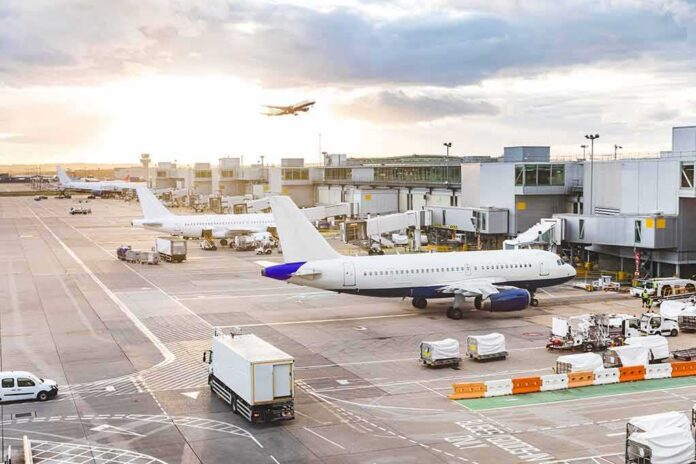
Europe’s skies stayed safe, but at least 11 flights were jolted by bomb threats that triggered diversions, searches, and even fighter-jet escorts across several countries.
Story Snapshot
- Airlines diverted and searched planes after emailed or anonymous bomb warnings.
- No explosives were found on the inspected aircraft, according to officials and airlines.
- Incidents hit LOT, Wizz Air, Ryanair, and Scandinavian Airlines flights, among others.
- One plane received a military escort; several airports paused normal operations.
Verified disruptions across multiple airlines and countries
Officials and airlines confirmed concrete steps: diversions, emergency landings, airfield searches, and security sweeps. The Associated Press reported bomb-threat responses involving LOT, Scandinavian Airlines, Wizz Air, and Ryanair, with one plane escorted by the Italian Air Force until landing. The British Broadcasting Corporation said two Ryanair jets that landed in Rome were searched after anonymous warnings and cleared with no explosives found. These moves reflect standard aviation rules: treat a credible threat as real until cleared.
LOT diverted a Warsaw Chopin flight to Warsaw Modlin, where authorities searched the aircraft and found nothing, then reopened the airport after a brief closure. Wizz Air reported that a London Luton flight made an emergency landing in Budapest after a bomb threat; a Hungarian fighter jet escorted the plane, and later checks found nothing on board. These cases mirror a pattern repeated across several countries, where flights landed safely and were methodically inspected before being released back to service.
No devices found, but procedures did their job
Transport and police officials stated that inspections on affected aircraft turned up no explosives or suspicious items. Bulgaria’s transport ministry and Czech police each reported clear results after plane searches, reinforcing that the warnings did not match an actual device on board. Aviation security treats the threat itself as the hazard. That approach explains diversions, ramp checks, and passenger and baggage screening that follow even a single email warning. This conservative posture puts safety first and keeps risk near zero.
Across several airports, security teams followed well-practiced checklists shaped by lessons since the September 11 attacks: isolate the aircraft, screen people and bags, sweep the airframe, and release only after a full clearance. That is why a single message can disrupt a flight plan yet still end with passengers safe, crews calm, and metal intact. Conservative readers who value order and deterrence should welcome that trade: brief inconvenience now to prevent tragedy later.
Counting incidents and the question of scale
Newsrooms cited different totals as events rolled in. Reports ranged from seven flights on a given day to at least 25 over a week. That spread reflects how outlets count by day, by aircraft, or by ongoing investigations. The Associated Press documented searches and diversions across multiple carriers in one day; other reports added later cases as authorities updated their logs. The number matters less than the verified fact pattern: repeated threats forced repeated safety actions across Europe.
9 AM Top-of-the-Hour News
Bomb threats have caused diversions and emergency landings for at least 25 flights across Europe.: “The series of warnings Thursday affected flights between Italy, Ireland, the UK, Spain, Bulgaria, Romania, Poland, Finland, Austria, Denmark, Belgium,… pic.twitter.com/nHNxX9coEh
— Worldwide News Network (@WorldwideNNX) November 5, 2026
Experts quoted by major outlets said the clustering looked unusual. Aviation security specialist Paul Mason said bomb threats on passenger planes do not happen often, and the scale suggested a deliberate actor rather than random coincidence. That view tracks with common sense: when many flights receive warnings in tight windows, coordination is a fair hypothesis. Authorities have not named a perpetrator, and responsibility remained unclaimed in early reports. That is a familiar gap in early-stage security cases.
Why this mattered beyond airport fences
The wave showed how a low-cost message can trigger a high-cost response. Airports paused operations. Passengers, crews, and bags were screened. Military and police assets launched. Airlines absorbed delays and diversions. Even when every plane lands safe and clean, the playbook still burns time, trust, and money. That is the point of malicious hoaxers: grind the system with fear while avoiding the risks of a real attack. Strong, consistent enforcement is the remedy.
What worked, and what to watch next
Authorities kept risk to passengers near zero by moving fast and checking everything. LOT, Wizz Air, and Ryanair communicated essential facts without fueling panic, while police and ministries released clear outcomes: no explosives found. That calm, by-the-book posture serves public safety and keeps copycats guessing. The next step is methodical attribution. Investigators will chase sender data and timing patterns. When they find the operator, courts should make the cost of hoaxes painfully clear.
Sources:
facebook.com, edition.cnn.com, cbsnews.com, bbc.com, scmp.com, bbc.co.uk
© horizonpost.com 2026. All rights reserved.