

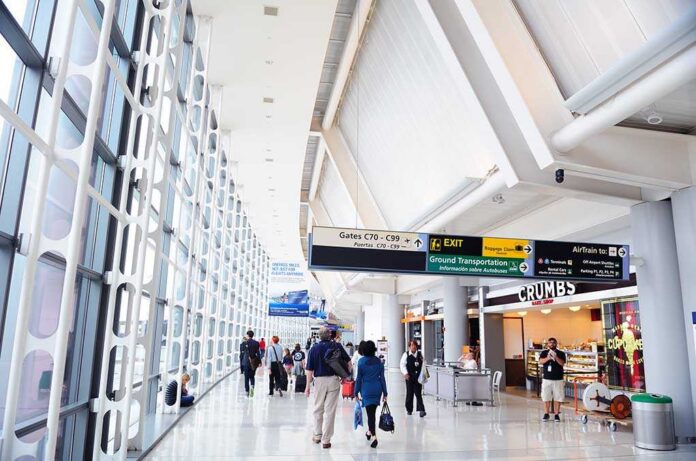
horizonpost.com — The federal government just turned Atlanta’s Hartsfield-Jackson airport into a medical checkpoint, and the real story is not Ebola—it is how far Washington will go in the name of “layered” safety.
Story Snapshot
- Mandatory Ebola screenings now route certain travelers through a handful of U.S. airports, including Atlanta.
- Centers for Disease Control and Prevention (CDC) officials frame this as one piece of a broader “layered” containment strategy.[2]
- Critics question whether adding Atlanta meaningfully improves safety or mainly creates theater, delays, and government overreach.[1]
- The fight is really over trust: do Americans accept sweeping controls without hard evidence of benefit?
Mandatory screening arrives in Atlanta with federal backing but thin public proof
Mandatory Ebola screening for travelers is now active at Hartsfield-Jackson Atlanta International Airport for people who recently spent time in the Democratic Republic of the Congo, Uganda, or South Sudan.[1] Federal routing rules require United States citizens and permanent residents who were in those countries within the last 21 days to enter through designated airports, including Atlanta, where they undergo health checks before clearing the border.[1] Officials have not published how many travelers are affected or how long these emergency measures will last.[1]
The Centers for Disease Control and Prevention (CDC) formally expanded “enhanced public health entry screening” to Hartsfield-Jackson effective May 22, 2026, at 11:59 p.m. Eastern time.[2] Washington-Dulles International Airport began the same protocol two days earlier.[2] The CDC emphasizes that Atlanta is not improvising; the airport previously conducted similar Ebola screening in past outbreaks and already has operational procedures in place.[2] The agency’s messaging clearly aims to signal competence and continuity, not panic or experimentation.[2]
CDC’s layered approach mixes real containment with visible theater
The CDC describes enhanced entry screening as only one component of a “layered public health approach.”[2] Officials point to overseas exit screening, airline illness reporting, and post-arrival public health monitoring as additional layers designed to catch Ebola cases early and track at-risk travelers.[2] That structure mirrors how large bureaucracies often respond to low-probability, high-consequence threats: stack multiple safeguards, display them visibly, and hope the combined effect compensates for any one layer’s weaknesses.
Public health planners would argue that routing a small number of travelers through a few airports allows trained teams to concentrate expertise, equipment, and follow-up.[1][2] From that perspective, adding Atlanta as a second hub next to Washington-Dulles spreads the burden while keeping the funnel relatively tight.[2][3] This logic fits the conservative instinct for targeted, limited interventions rather than universal clamps on the entire travel system. The question is whether this layer is sharp enough to justify the cost in freedom and resources.
Conservative questions: data, burden, and mission creep
The public record so far does not show that the CDC backed the Atlanta expansion with a published, quantitative risk model.[2] Government briefings describe the move as part of a prudent layered strategy, but they do not provide numbers on detection rates, false negatives, or the marginal risk reduction from adding Atlanta versus keeping all screening at Washington-Dulles.[2] Policy rooted in science should come with transparent metrics; when it does not, Americans are right to ask whether they are getting science or optics.
"Mandatory Ebola screenings have officially expanded to Hartsfield-Jackson Atlanta International Airport for travelers arriving from the DRC, Uganda, and South Sudan. 🚨
Those who pass will still face 21 days of strict symptom monitoring by local health departments.
— Mazi okwuoma (@MaziEzike_Nedu) May 26, 2026
News coverage notes that officials have not reported Ebola-positive travelers linked to Atlanta in this phase of the outbreak.[1][3] That absence could indicate success upstream—exit screening and local control in Africa—or it could mean the airport procedures mainly process healthy people. Screening that rarely finds cases can still have value as a deterrent and a coordination tool, but common sense demands a cost-benefit reckoning: how much staff time, money, and traveler disruption justify catching one case, if that case shows up at all?
Liberty, limited government, and the risk of “temporary” controls
The federal routing rules force United States citizens and permanent residents who visited the affected African countries to pass through specific airports for mandatory screening, regardless of their final destination.[1] That arrangement centralizes control in Washington and turns certain hubs into de facto health checkpoints. Many Americans accept short-term inconvenience for genuine threats, but they also remember how quickly “temporary” measures—airport security lines, surveillance tools, emergency powers—tend to linger after the crisis passes.
This policy raises classic conservative concerns about mission creep. Health screening for a deadly virus is a legitimate government function, but once the infrastructure for selective travel routing and mandatory checks exists, future administrations can repurpose it for broader agendas that have nothing to do with Ebola. A principled approach insists on hard sunset clauses, transparent criteria for activation, and public evidence that each new layer genuinely improves safety, not just political cover.
What smart prudence should look like going forward
Ebola is a brutal disease, and few would argue for open borders in the middle of an African outbreak. The real dispute is over calibration. A conservative, common-sense standard would demand that the CDC publish clear metrics: how many travelers are screened, how many are flagged, what follow-up occurs, and under what conditions the agency will scale the program back.[2] That transparency would allow citizens to judge whether Atlanta’s screening hub is a sharp tool of targeted defense or a blunt instrument of bureaucratic habit.
Airport screening will always be tempting because it is visible, controllable, and easy to explain on television.[3] But visibility is not the same as effectiveness. For Americans who value both safety and limited government, the right posture is skeptical vigilance: support Ebola controls that are tightly focused, time-limited, and backed by open data, while resisting the quiet normalization of permanent medical checkpoints at the nation’s gateways.
Sources:
[1] Web – Ebola-related travel restrictions now include Atlanta’s Hartsfield …
[2] Web – Enhanced Ebola Airport Screening Expands to Atlanta – CDC
[3] Web – US names second airport for Ebola screening as cases in Congo …
© horizonpost.com 2026. All rights reserved.