
A United flight squawked the hijack code after a passenger claimed he had a bomb and moved for the cockpit.
Story Snapshot
- United Flight 2174 reported an attempted cockpit breach and triggered a top-level hijack alert.
- Deputies arrested 34-year-old Rony Alexander Gomez-Alberto after the plane landed in New Orleans.
- Homeland Security said Gomez-Alberto is a Honduran national with two prior removals and an active detainer.
- Local charges include terrorizing and false bomb-threat related offenses, not a federal hijacking count.
A hijack alert in the air, a calm takedown on the ground
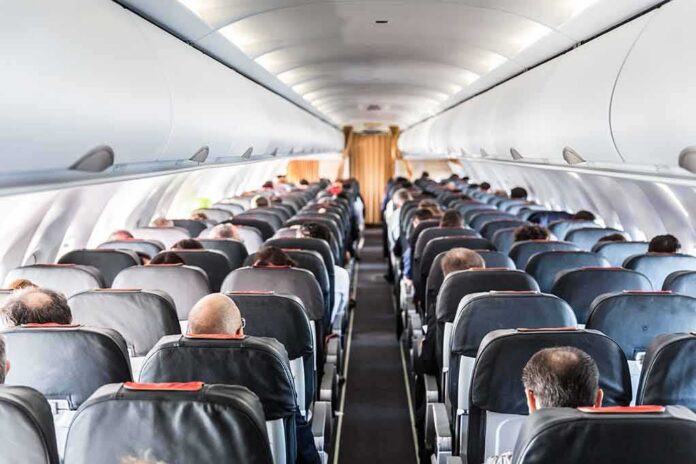
United Flight 2174 from Newark to New Orleans sent an attempted cockpit-breach report and received a Level 4 hijacking alert while airborne. The airline and Jefferson Parish Sheriff’s Office described a passenger who claimed he had a bomb and moved toward the flight deck. Pilots continued to New Orleans. Deputies boarded after landing and made the arrest without injuries to passengers or crew. The plane carried 46 passengers and six crew, according to local accounts.
Jefferson Parish deputies identified the suspect as 34-year-old Rony Alexander Gomez-Alberto. Local coverage reported that he acted irrationally and told crew he had a bomb. Authorities booked him on state charges, including communicating false information of planned arson and terrorizing. Other outlets described felony bomb-threat and disorderly-conduct counts. No explosive device was reported found in the public accounts cited by officials and media at the scene.
DHS says suspect twice removed, now on an immigration detainer
The Department of Homeland Security stated that Immigration and Customs Enforcement issued a detainer for Gomez-Alberto after the flight. The agency said he attempted to gain entry to the cockpit during the flight. Department accounts also said he is a Honduran national who was deported in 2011 and again in 2014 after reentering unlawfully, and that he is now a criminal illegal immigrant in custody at the parish level pending immigration action.
Fox News, citing Homeland Security, reported the specific sequence: a crossing near Texas in 2011, removal, another crossing through New Mexico in 2014, removal again, and a current detainer lodged with Jefferson Parish. Those details match the broader pattern seen in immigration reentry cases, where repeat unlawful entries can lead to federal prosecution if referred by the Department of Justice (DOJ) after local proceedings wrap.
Why a bomb claim triggers the highest aviation response
A cabin bomb claim and a move toward the cockpit trigger the same early response as a real hijack. Flight crews cannot assume it is a bluff. Federal guidance treats three buckets of crime in these events: making threats or false information, interfering with crew, and attempted aircraft piracy. The United States Department of Justice manual explains that attempted piracy can apply even on the ground, and does not require a completed takeover to charge the offense.
🇺🇸 UPDATE: The passenger accused of making a bomb threat and attempting to breach the cockpit of a United Airlines flight has been identified as Rony Alexander Gomez-Alberto, 34, a Honduran national.
According to DHS, Gomez-Alberto was previously deported from the U.S. twice and… https://t.co/SEWscHxXZ4 pic.twitter.com/nhRWH5GhKY
— NewsForce (@Newsforce) November 11, 2026
Airline disruptions rose sharply after 2019, peaking during 2021, and remain well above pre-2020 levels. The Federal Aviation Administration and Federal Bureau of Investigation now coordinate on the most serious unruly cases. That approach explains why a single passenger’s threat can lock down a plane, trigger a hijack transponder code, and summon law enforcement on landing. Speed and clarity save lives when the threat is real. The cost is disruption when it is not.
Charges now, more reviews possible later
Local authorities booked state charges first. That is normal. Prosecutors often start with the clearest counts supported by quick witness statements: terrorizing, false information, or interference with crew. If federal agents later assess the facts as attempted aircraft piracy, they can seek federal charges. The Justice Department’s public-order guidance outlines separate statutes for attempted piracy, crew interference, and false threats on aircraft within United States jurisdiction.
This case also exposes the border-to-cabin link. Homeland Security says the suspect twice defied removal orders and reentered. Common sense says a system that ignores repeat illegal entries invites risk on the ground and in the sky. Conservatives see a simple fix: enforce the law at the border, detain repeat offenders, and remove them fast. That approach protects flight crews and families who expect safe travel without midair scare drills.
What matters next for flyers and families
United and law enforcement will review cockpit-door protections, crew actions, and passenger handling. The Federal Aviation Administration has pushed for layered barriers since 2001. A newer secondary barrier concept adds a physical block when the cockpit door opens, closing small gaps that bad actors might exploit. Officials credit these layers with preventing post-9/11 attacks on United States aviation, even as disruptive incidents continue to test the system.
One caution belongs here: an arrest is an allegation, not a conviction. Still, the essentials stand. A man claimed a bomb, moved toward the cockpit, and the crew and cops followed the playbook. The parish brought charges. Homeland Security lodged a detainer and cited two prior removals. That sequence is exactly how a healthy security system should work—fast in the air, firm on the ground, and clear about who is responsible for what.
Sources:
thegatewaypundit.com, wwltv.com, foxnews.com, nypost.com, timesnownews.com, justice.gov
© horizonpost.com 2026. All rights reserved.