
The Supreme Court just handed President Trump the keys to the administrative state’s engine room.
At a Glance
- The Court struck down the Federal Trade Commission’s for-cause removal limit as unconstitutional.
- The ruling restores the President’s power to remove Federal Trade Commission commissioners at will.
- The decision reverses a lower court and sends the case back for further action.
- The opinion anchors a wider shift toward stronger presidential control over executive agencies.
What The Court Actually Decided
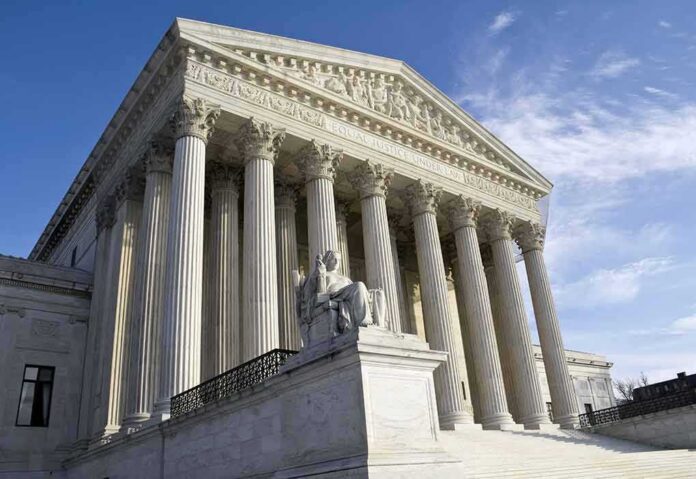
The Supreme Court held that Congress cannot block the President from removing Federal Trade Commission commissioners by forcing “for-cause” limits on that power. The majority said those limits violate the Constitution’s structure and the President’s duty to control those who wield executive power. Chief Justice John Roberts wrote the opinion. The Court reversed and remanded the case, which means the lower court must now apply this new rule to the facts. The holding is crisp: subordinates who exercise the President’s power are subject to removal by him.
The decision arose after President Trump told Commissioner Rebecca Kelly Slaughter in March 2025 that he was removing her. The Federal Trade Commission Act had allowed removal only for “inefficiency, neglect of duty, or malfeasance.” A lower court blocked the removal and issued an injunction. The Supreme Court took the case, framed the question squarely, and then said the for-cause shield cannot stand under the separation of powers.
Why This Case Breaks The Old Mold
For decades, many called the Federal Trade Commission “independent.” That label rested on a 1935 ruling called Humphrey’s Executor, which let Congress give commissioners for-cause protection. Recent cases chipped at that idea. The Court first struck the shield for the Consumer Financial Protection Bureau’s single director in 2020. It then narrowed agency independence again in later cases. This ruling continues that path by restoring the President’s removal power over a multimember regulator.
The Court’s move fits a simple logic chain. The Constitution vests the executive power in the President. People who enforce laws or bring cases act with that power. The President must be able to remove those people to stay accountable for results. Congress can design agencies, set missions, and fund them. But it cannot lock key officers in place and still expect the President to “take care” that the laws are faithfully executed. That structure favors energy in the executive and clear lines of duty.
What Changes Tomorrow Morning
The Federal Trade Commission’s top layer is now directly answerable to the President. That means faster course changes on antitrust, data privacy cases, merger policy, and rulemaking priorities. The White House can remove commissioners who refuse to carry out lawful directives consistent with agency statutes. Career staff still do their jobs. But the elected President can steer the ship without fighting a legal wall built to resist him at every turn.
Expect ripple effects. Other multimember boards with for-cause language will face challenges. General counsels across agencies will review charters and risk maps. The Department of Justice will likely cite this case in fresh filings. Congress will debate how to draft oversight without crossing the removal line again. Markets will price in swifter regulatory pivots. Businesses weighing mergers may see clearer signals, for better or worse, but with fewer mixed messages from insulated commissioners.
How This Aligns With Constitutional Trajectory
The ruling reinforces a long trend toward a unitary executive. The Supreme Court in recent years has said the President must keep control over those who execute the law. That shift narrows the space for “independent” power centers that set policy without clear presidential oversight. The Court did not erase every agency design choice. It did, however, say that insulation that blocks removal crosses the constitutional line when officers use executive power.
This approach tracks common sense and conservative values. Voters know who to blame or praise for results: the President. Accountability dies when unelected boards can defy elected leadership and still wield prosecutorial and regulatory muscle. Supervision does not mean lawless orders. It means the same thing it means in any job: if you carry someone’s power, you answer to that person. The Court put that simple rule back in charge of federal governance.
What President Trump Can Do Now
First, set clear directives for the Federal Trade Commission on enforcement focus, merger reviews, and rulemaking calendars. Second, refresh leadership to match those directives, removing and replacing commissioners who resist lawful priorities. Third, align cross-agency actions where the Federal Trade Commission overlaps with the Department of Justice Antitrust Division to reduce turf wars and speed outcomes. Fourth, push for legislative updates that respect removal while strengthening transparency and reporting to Congress.
Faster decisions are coming, but speed must come with guardrails. Publish guidance in plain language. Set timelines that the public can track. Tie agency moves to clear statutory hooks. Use this authority to cut backdoor lawmaking by guidance memos and settle-for-cash enforcement that dodges the courts. Lean on courts for final word when stakes are high. Stronger presidential control works best when paired with sunlight and firm respect for the text of the law.
Sources:
supremecourt.gov, supreme.justia.com, constitution.congress.gov, congress.gov
© horizonpost.com 2026. All rights reserved.