
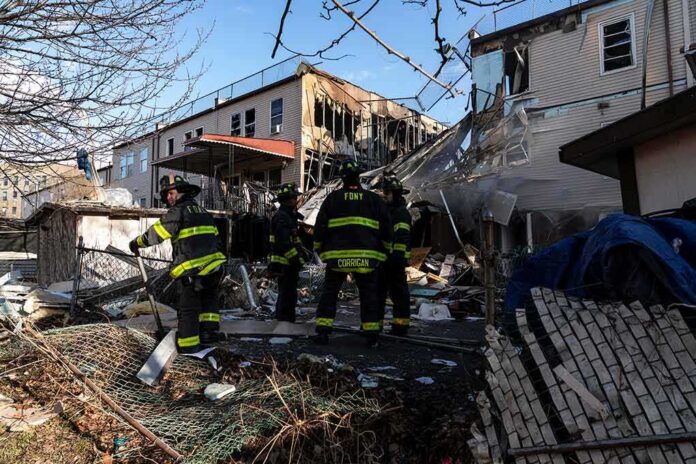
Firefighters clawed through a tangle of brick and timber in Flatbush as two people were pulled from the rubble and the search pressed on for others.
Story Snapshot
- Fire Department of New York led a major technical rescue after a Brooklyn building collapse
- Two people were removed from the debris as searches continued for others
- The collapse hit near Bedford Avenue by Newkirk and Flatbush, just after 4 p.m.
- Officials warned of road closures and told the public to avoid the area
Rescue teams surged into Flatbush within minutes
Fire Department of New York units, New York Police Department Emergency Services Unit officers, and specialized urban search and rescue teams converged near Bedford Avenue between Newkirk and Flatbush after a building partially collapsed shortly after 4 p.m. Crews launched a hand-by-hand grid search across unstable debris. Reporters on scene showed firefighters digging and moving victims on stretchers as the operation grew in size and urgency. Responders treated the scene as a major technical rescue with an open search window.
Authorities confirmed that two people were removed from the wreckage and evaluated by emergency medical personnel as crews kept looking for others. Earlier reports described people possibly trapped inside. The Fire Department of New York labeled the response “major,” and that framing matched what camera crews recorded: firefighters advancing into voids, spotters watching shifting walls, and teams rotating as night approached. A later update from local coverage reported at least one death and multiple injuries linked to the collapse.
Where it happened and how the response unfolded
Dispatchers flagged the incident at or near 2625 Bedford Avenue at about 4:01 p.m., placing the collapse in the Flatbush corridor beside active traffic and footpaths. Coverage referenced nearby addresses that may reflect the collapsed structure and an adjacent worksite, with some reports noting 1321 Flatbush Avenue and 2621 Bedford Avenue. Those descriptions mapped to the same corner zone where responders staged ladders, rescue tools, and heavy shoring to stabilize entry points. The search plan focused on life safety first, then structure support.
Officials closed streets, pushed back crowds, and warned drivers to avoid the area while the search continued. The city’s emergency management office signaled longer delays as cranes, lights, and shoring material moved in. This control buys time when the clock works against trapped survivors. It keeps vibrations down, clears access for ambulances, and lets chiefs track each crew’s position. Good command avoids secondary collapses. That discipline showed in the tight perimeter and steady tempo on the pile.
What we know about victims, video, and on-scene evidence
Two rescues were confirmed by the Fire Department of New York, with both patients assessed on site and transferred for care. Video from multiple outlets showed firefighters guiding at least one person on a stretcher away from the debris field. Those images matched the agencies’ account of active rescues and ongoing searches for others who could be inside void spaces. A later tally from local reporting cited one fatality and several injuries, capturing the hard shift from rescue to medical triage as the evening wore on.
FDNY units continue to operate Thursday morning at the site of a building collapse on Flatbush Avenue in Brooklyn: pic.twitter.com/KP1oVr1sn3
— FDNY (@FDNY) November 12, 2026
Cause remained under investigation. Coverage noted excavation and construction activity near the collapse footprint, but officials had not made a final call on what failed. That distinction matters. Rescue demands speed and care; investigations need time and records. New York’s Department of Buildings will review permits, inspections, and any prior violations tied to the adjacent site and the collapsed structure. That process tests whether design, oversight, or workmanship contributed to the failure.
Why the response cadence looked like this
Serious collapses follow a predictable rhythm. First minutes decide life or death, so chiefs flood the zone with ladders, rescue companies, and medical units. Crews silence the scene, listen for taps or cries, and probe voids methodically. They brace unstable walls before pushing deeper. Public messages stress road closures and ask people to steer clear, which protects both the trapped and the teams trying to reach them. That is what played out on Bedford Avenue as the search stretched from daylight into evening.
Coverage of these events also changes by the hour. Early reports highlight unknowns, rescued individuals, and live images of firefighters at work. Later updates turn to the casualty count, the building’s history, and the construction records next door. That pattern appeared here: two confirmed removals early, then a reported death and broader injury count as facts firmed up. One sentence of caution belongs here: early numbers often shift as hospitals report and investigators reconcile addresses and unit logs.
Accountability comes after the last victim is found
New York has reduced construction incidents in recent years through sweeps, safety reports, and stricter enforcement, but one failure is too many when homes and lives are at stake. A clear investigation should sort cause from coincidence, with records over rumors. Conservative common sense backs that order: save every life you can, secure the site, then show the paperwork and name where controls broke down. Flatbush residents deserve that clarity, and so do the firefighters who risked everything on that pile.
Sources:
fox2now.com, whmi.com, cbsnews.com, fox56news.com, pix11.com
© horizonpost.com 2026. All rights reserved.