
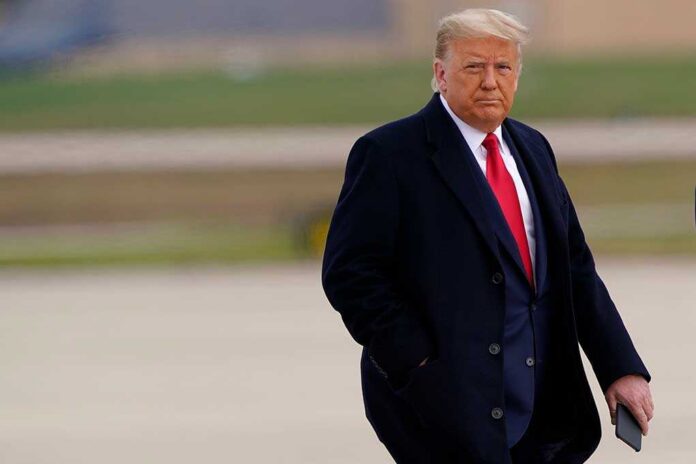
Trump’s fiery clash with a BBC reporter over an Iran school bombing question has again exposed how legacy media try to script the story for him—and then blame him for refusing to read their lines.
Story Snapshot
- Trump blasted a BBC reporter as “fake” after a question tying him to a deadly strike on an Iranian girls’ school.
- The only public clip of the exchange is fragmentary, leaving the exact wording and premise of the BBC question unclear.
- Trump’s answer did not concede guilt and instead referenced ongoing investigations into what actually hit the school.
- The dispute highlights long‑running conservative concerns about biased war reporting and narrative‑driven coverage by outlets like the BBC.
Trump Clashes With BBC Over Iran School Strike Question
Video from a recent press exchange shows President Donald Trump bristling when a BBC reporter pressed him about reports that a United States missile struck a girls’ school in Iran at the start of the 2026 Iran war, killing well over one hundred people.[3] The reposted clip circulating online captures the reporter asking whether he could confirm that a United States weapon hit the school and Trump immediately pushing back, calling the network “fake BBC” and accusing it of putting words in his mouth.[3]
The ModernGhana repost of the segment, titled “Trump responds to question on Iranian girls’ school strike,” shows the president answering as if the premise of an Iranian school bombing had already been framed before the snippet begins.[1][3] However, the repost does not include the full question, the lead‑in, or the follow‑ups, so viewers cannot see exactly how the BBC journalist described the alleged incident. That missing context makes it difficult to judge whether Trump’s anger answered a fair question or a loaded accusation.[1][3]
What We Know—and Do Not Know—About the Minab School Attack
The backdrop to the exchange is the Minab school attack, an early and deeply controversial episode in the 2026 Iran war.[4] According to open‑source chronicling of the conflict, multiple independent investigations later concluded that the United States was responsible for the strike on a girls’ school in the Iranian city of Minab, with casualty counts in the range of roughly 150 people, including a large number of children. United Nations statements and humanitarian organizations condemned the attack and demanded a full accounting.
Reports indicate that, in the immediate aftermath, senior officials in the Trump administration, including Secretary of Defense Pete Hegseth, publicly said the Pentagon was “investigating” whether a United States missile hit the school.[2] That posture signaled neither a clear admission nor a denial, but an acknowledgment that something serious had happened and that facts were still being sorted out. Trump’s own initial comments about the supposed school strike, captured in separate clips, include the line “I do not know about that,” which underscores that he did not simply accept the most explosive allegations at face value.[2][3]
Trump’s “AI in My Mouth” Complaint and Conservative Skepticism of BBC Framing
During the contested exchange, Trump not only labeled the BBC “fake” but also quipped that they were “the ones who put AI in my mouth,” a reference to a wave of artificial intelligence generated videos used by Iranian propaganda outlets and some Western commentators to depict him gleefully ordering massacres. That remark captured a broader frustration on the right: the sense that both foreign adversaries and establishment media are eager to attribute words or intentions to Trump that he never actually expressed, then treat the fabricated version as fact.
Conservative critics have pointed out that the only widely accessible record of the BBC question is a secondary repost with sensational on‑screen captions, not the full raw feed or official transcript.[1][3] They argue that without knowing exactly how the reporter framed the Minab incident—what casualty numbers were cited, whether “war crime” language was used, whether responsibility was asserted rather than asked—the public cannot fairly judge Trump’s reaction. The risk is that a clipped video and a headline become the permanent narrative, while the underlying sourcing of the question remains unscrutinized.[1]
Media Accountability, Civilian Casualties, and the Cost of Narrative Warfare
The BBC, along with other international outlets, has framed the Minab school strike as part of a larger story about transparency and accountability in Trump’s conduct of the Iran war.[4] Former military officers interviewed by BBC radio have criticized what they call a “marked absence of accountability” from the Pentagon after the attack and have urged clearer public explanations of targeting decisions and intelligence failures. Those concerns resonate with many Americans who believe their government should be honest about civilian harm, even during just wars fought in self‑defense.
BREAKING: TRUMP CRASHES OUT ON BBC REPORTER FOR ASKING ABOUT US STRIKE ON MINAB GIRLS SCHOOL AT START OF IRAN WAR:
REPORTER: Admiral Cooper was asked yesterday about the strike on the girls' school
TRUMP: Well, it's under investigation
REPORTER: Are you able to confirm it was… pic.twitter.com/e9Hg3diJXe
— 𝐀𝐥𝐦𝐨𝐮𝐬𝐚𝐰𝐢_𝐇𝐐 (@Almuosavi_hq) May 15, 2026
At the same time, conservatives watching the BBC’s coverage see a familiar pattern: rush to highlight the worst interpretation of United States actions, lean hard into emotionally charged imagery, and then use any hesitation or caution from the administration as proof of guilt or cruelty. The fragmented record around the BBC’s question to Trump—no full transcript, no unedited pool video in public, and only secondary clips with dramatic titles—fits that concern.[1][3] In a media environment already polluted by artificial intelligence fakes and partisan editing, many on the right view Trump’s instinctive pushback as a necessary defense of both his administration and the country.
Sources:
[1] Web – Trump responds to question on Iranian girls’ school strike
[2] YouTube – Hegseth asked about bombed Iranian school, Trump reacts to new …
[3] YouTube – Trump on Iranian school bombing: “I don’t know about that”