
About one in five U.S. states refused to show up to Trump’s Great American State Fair — then Pennsylvania’s own senators stepped in to make sure the Commonwealth didn’t go missing from America’s 250th birthday party.
Story Snapshot
- Roughly one-fifth of U.S. states skipped the Great American State Fair, refusing to send official delegations or spend public money on the event.
- Pennsylvania’s governor boycotted, but Senators Dave McCormick and John Fetterman — a Republican and a Democrat — teamed up with state businesses to fill the gap.
- Trump claimed 45,000 people attended. NBC News called that claim false, saying actual totals were nowhere close.
- Headlining acts including Martina McBride, Brett Michaels, and The Commodores all canceled after learning the event was centered on Trump.
Ten States Said No — Then Two Senators Said Yes
Pennsylvania Governor Josh Shapiro sat the fair out, calling it politicized and Trump-centric. That left the Commonwealth without a seat at an event designed to include all 50 states. Senators Dave McCormick and John Fetterman had a different idea. The two senators — one Republican, one Democrat — announced a partnership with Pennsylvania businesses to make sure the state showed up anyway.[10] That kind of bipartisan move is rare enough to be worth noticing.
The senators’ decision matters beyond Pennsylvania. About one-fifth of the nation’s states refused to send official delegations or spend public money on the fair.[2] That is a significant number of states choosing to make a political statement over a national birthday celebration. Whether you agree with the boycott or not, ten states turning their backs on America’s 250th anniversary event sends a message that cuts both ways.
The Crowd Size Fight Nobody Can Settle
Trump told reporters the fair drew 45,000 guests. NBC News reported that claim was false and that actual attendance was nowhere near that number.[2] No independent attendance figures were released by the White House to settle the dispute. Fox News reported “thousands” celebrating at the event, which is a very different picture than the sparse opening day crowds that critics described.[9] Without satellite data or cell-phone density analysis, both sides are essentially arguing over a number nobody can prove.
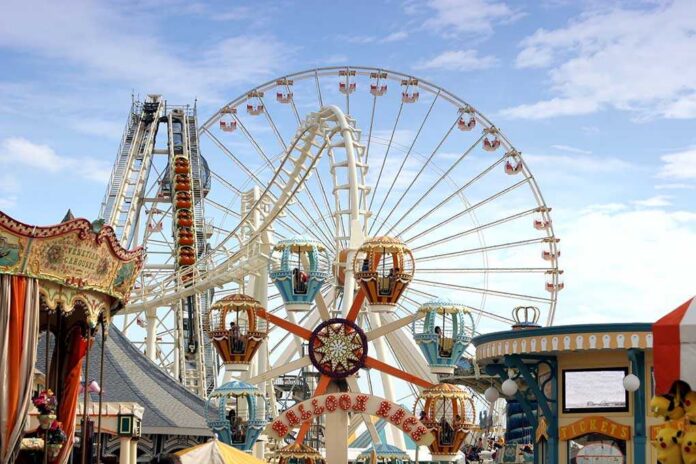
What is documented is this: the fair opened with thin crowds, a broken ferris wheel, electrical problems, and melting ice cream.[1] Headlining acts Martina McBride, Brett Michaels, and The Commodores all canceled weeks before the event after learning it was built around Trump.[1] Video footage showed a steady stream of people leaving during Trump’s speech. Those are facts that even enthusiastic supporters of the event have not directly challenged.
The Confederate Flag Controversy That Cost a Sponsor
North Carolina’s display at the fair featured the Confederate stars and bars — a flag that was never part of the state’s official flag. The governor demanded its removal. The fair’s primary corporate sponsor then cut financial ties with the display entirely.[1] That sequence of events is hard to spin as a minor hiccup. A national celebration of American unity is a strange place to fly a flag that symbolizes division, and the corporate exit suggests even fair-friendly businesses knew it.
Trump’s State Fair Faces Fresh Embarrassment!
Amid the Sparse Attendance, Empty Spaces & just Two Rides at Trump's Long-Promised "Great American State Fair," Some Attendees Managed to Make an Interesting Discovery! But It Likely Won't Please Trump! https://t.co/vTs28OD1VT pic.twitter.com/FqkJIIqfF5— D. Lesser (@HarleyGal54) June 28, 2026
State-level boycotts of federal events are not new in American history. Research shows that political boycotts are widespread and rising among Americans, driven largely by partisan identity.[19] But history also shows that boycotts rarely produce measurable policy change without sustained coordination and leadership. The states that skipped the fair made a statement. Whether that statement changes anything is a different question entirely.
What the Pennsylvania Model Actually Proves
The most interesting story here is not the boycott. It is what McCormick and Fetterman did instead. A Republican and a Democrat looked at a political standoff and decided their state’s presence at a national event mattered more than scoring points. Pennsylvania businesses joined them.[12] That is not a partisan move — that is a practical one. States that boycotted chose symbolism. Pennsylvania’s senators chose representation. Voters watching from home can decide which approach serves their state better.
America’s 250th birthday deserved better than a food fight over attendance numbers and political loyalty tests. The fair was free to attend.[3] The argument was never really about cost for regular citizens — it was about whether state governments would spend public money to participate officially. That is a legitimate debate. But letting that debate erase a state’s presence at a once-in-a-generation national milestone is a choice with consequences that outlast any news cycle.
Sources:
[1] Web – 10 States Boycott the Great American State Fair, But PA Senators and …
[2] Web – ‘Packed to the brim’: Trump says 45K guests attend Great … – WCIV
[3] Web – Trump scrambles to exaggerate pitiful crowd size at Great American …
[9] Web – The Great American State Fair is off to an incredible start! Freedom …
[10] Web – Thousands celebrate America 250 at Great American State Fair in DC
[12] Web – PA officially to not participate in the Great American State Fair – …
[19] Web – [PDF] A CASE FOR THE POLITICAL BOYCOTT – West Virginia Law Review
© horizonpost.com 2026. All rights reserved.