
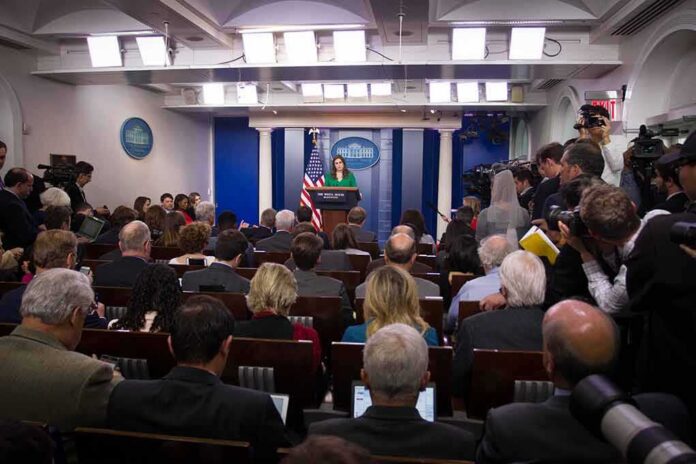
President Trump said he is banning CNN, MS NOW, and Politico from the White House, effective immediately, for what he called fake news.
Story Snapshot
- Trump announced a ban on three outlets from White House access, citing false reporting.
- The White House now runs a “Media Offenders” site cataloging alleged false stories.
- Press-freedom groups argue viewpoint-based bans likely violate the First Amendment.
- Courts have warned against arbitrary, content-based denial of White House credentials.
What Trump Announced And Why It Matters
President Trump said Friday he is banning CNN, MS NOW, and Politico from the White House, and hinted more bans could follow. His message blamed “fake news” and “fiction or lies” for the action, framing it as a correction to biased coverage. The post did not spell out logistics, like hard-pass status or event access, which leaves enforcement questions. The move lands in the tightest spot of American free speech law: government control of access versus press independence.
The announcement connects to a larger White House project to shame what it calls misinformation. The official “Media Offenders” page labels itself a record of false and misleading stories and features an “offender” list and submissions portal. That page signals an aggressive posture. It tries to flip the script: if the press claims to hold power to account, the White House claims equal duty to call out error. The fight now shifts from rhetoric to access, where the First Amendment stakes rise.
What The Law Says About Press Access
American courts do not guarantee reporters a right to every room, but they do set lines. The Reporters Committee for Freedom of the Press argues that excluding an outlet for its viewpoint violates the First Amendment, pointing to established case law on White House press credentials. The Knight First Amendment Institute says the government cannot bar newsrooms from core access based on editorial judgments, which is quintessential viewpoint discrimination. Those claims aim directly at bans tied to “unfavorable coverage.”
Freedom Forum explains a practical test: the White House can impose reasonable, viewpoint-neutral rules, but cannot punish a newsroom for its stance or reporting content. That matches common sense and conservative values. Government should set clear, even rules, applied the same to everyone. If a rule looks like punishment for criticism, it crosses a constitutional line. If it targets conduct, security, or space limits, and applies equally, it stands on firmer ground. Which side this falls on depends on facts a court will test.
The Clash Between Accountability And Retaliation
The White House says it is documenting falsehoods and protecting the public square from misinformation. The “Media Offenders” portal formalizes that claim and invites tips from citizens. Advocates for the press call the bans retaliation for tough coverage, a move that chills reporting. CBS News framed this as part of a wider strategy to target outlets over their reporting, raising the temperature of the access fight. Both cannot be true at once; a judge will likely decide how to read intent and impact.
Conservatives value truth, order, and fairness. That means a White House can set standard rules and call out errors, but it should avoid viewpoint-based punishment that hands future presidents a censorship tool. If the administration shows neutral, objective criteria, applied across the board, it will strengthen its case. If the record shows the bans hinge on disfavored viewpoints alone, the legal risk mounts. The fastest path to win trust is sunlight: publish the access rules, enforce them evenly, and keep the receipts.
Sources:
cbsnews.com, timesnownews.com, staradvertiser.com, rollingstone.com, livenowfox.com, thewrap.com
© horizonpost.com 2026. All rights reserved.