
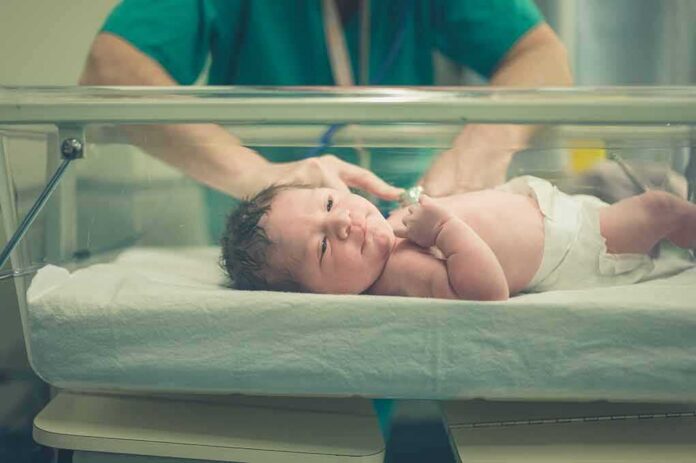
Five hours after a doctor declared 2-year-old Vincent dead, a morgue worker found him breathing.
Story Snapshot
- Police records say a medical examiner transporter found Vincent breathing in a hospital cold room.
- The discovery came more than five hours after a doctor called the time of death around 6:20 p.m..
- The family says they saw movement earlier; a guard said a doctor called it normal after death.
- Vincent survived and is recovering from a hypoxic brain injury at home.
What Police And Hospital Timelines Establish
Gilbert Police Department records state that a Maricopa County medical examiner transporter arrived at Mercy Gilbert Medical Center at 11:52 p.m. to collect Vincent and found him breathing in the hospital’s cold room. Reporting ties the initial pronouncement to about 6:20 p.m. by Dr. Aryan Toosi, setting a gap of more than five hours between “time of death” and signs of life. Police later informed the parents that staff observed breathing and movement, a detail carried in multiple accounts based on official records.
https://www.youtube.com/watch?v=LrCcQoXlq0o
AZFamily reported documents from the family’s attorney that show Vincent arrived near 6:04 p.m., was pronounced at 6:20 p.m., and that some test results posted at 6:38 p.m., after the pronouncement. Those timestamps do not decide fault on their own, but they matter. They draw a line between what was known when the call was made and what the record showed minutes later. In any emergency room, that line is the difference between certainty and risk.
The Cold Room Discovery And Witness Accounts
The medical examiner worker’s observation triggered a reversal of course. Staff moved Vincent from the cold room and transferred him for advanced care at Phoenix Children’s Hospital. The family’s lawyer, John Brewer, says he was told that all four of Vincent’s limbs moved under the sheet earlier, but a security guard said a doctor explained the motion as normal after death. That exchange, if recorded accurately, suggests a breakdown in who had authority to recheck the child and when.
Published reports say Vincent survived and returned home, where he is recovering from a hypoxic brain injury. That outcome confirms the central fact: the death declaration was wrong. It does not, by itself, answer whether anyone failed a clear duty in the minutes after resuscitation ended. The hospital issued a brief statement calling the situation heartbreaking and citing privacy laws, while affirming safety as a top priority. Dr. Toosi’s attorney expressed concern for the family and said the doctor is committed to high-quality care.
Why This Rare Event Demands Tight Procedures
Medicine has a name for sudden return of signs of life after efforts stop: Lazarus phenomenon. Reviews describe dozens of such cases over decades, most within minutes of ending chest compressions. The lesson is practical, not mystical. After resuscitation, teams need a defined observation period, repeated checks for a pulse and breathing, and a clear chain of command before bagging a body. Conservative common sense says do not move a child to a cold room until life is ruled out beyond doubt.
The mother of a toddler found alive in an Arizona hospital morgue in February more than five hours after he was pronounced dead said Wednesday, she thought she heard him breathing when she hugged him goodbye. https://t.co/CNNN5PtOHb pic.twitter.com/UiEEuvtUbo
— James Tate (@JamesTate121) October 23, 2026
Police timelines and the morgue worker’s observation set the stakes here. If a transporter can find breathing, the bedside team needs tools and rules that make that discovery happen sooner. Families deserve a transparent, step-by-step account of what checks were done and when. Hospitals earn trust by showing policies, fixing gaps, and training staff to pause, recheck, and escalate. The goal is not blame by headline; it is a safer protocol the next parent can count on.
Sources:
reddit.com, abcnews.com, people.com, thehill.com, independent.co.uk
© horizonpost.com 2026. All rights reserved.