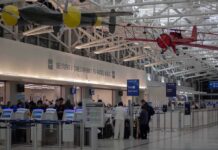


Delta’s automated weight-and-balance system went down on a peak holiday morning, and the nation’s busiest hub felt it within minutes.
Story Snapshot
- Delta said the outage hit automation used for preflight weight-and-balance checks.
- Crews used manual workarounds to launch flights while tech teams worked to restore systems.
- The Federal Aviation Administration shifted from a ground stop to a ground-delay program for Atlanta flights.
- Atlanta saw hundreds of delays with average waits near an hour reported during the surge.
What Failed And Why It Mattered Immediately
Delta reported an issue with automation that calculates aircraft weight and balance before takeoff. That process sets how bags, cargo, and passengers are distributed, and it gates the dispatch release. Without it, airplanes do not leave the gate. Delta said teams switched to manual procedures to keep departures moving while restoring the system. News outlets described the affected function as the tool that produces the data pilots and dispatch need to safely set power and speeds.
The Federal Aviation Administration treated the event as a Delta-side problem, not an air-traffic-control failure, according to reports that cited the agency. The agency initially halted Atlanta-bound Delta flights, then eased to a ground-delay program that paced departures into the hub. Advisories suggested staggered release times into early afternoon, a common method to prevent congestion while a carrier works its way back to normal.
How The Disruption Showed Up For Travelers
Atlanta’s departure boards stacked up red. Local reporting counted 364 delays tied to Atlanta, including about 200 inbound and 164 outbound flights, with average waits near 57 minutes at one point. Other outlets captured different totals during the morning push, which often happens when data snapshots come from different times or sources. Passengers saw rolling delays on Delta and schedule ripples across connecting flights, a typical pattern when a hub carrier slows its launch rate.
Delta told customers that crews were performing manual weight-and-balance work and that flight operations continued under those procedures while the company restored automation. That approach fits standard contingency playbooks. Manual load sheets and checks add time and require more coordination, but they let aircraft dispatch when computers stall. Crews, ramp agents, and dispatchers can do this safely, though throughput drops during peak periods.
Why Weight And Balance Is A Safety Gate, Not A Nuisance
Weight-and-balance figures drive takeoff performance and control. They tell pilots how much runway they need, what power to set, and where the airplane’s center of gravity sits. If those numbers are wrong, the aircraft can handle poorly, especially on short runways, hot days, or with heavy loads. Automation speeds those math steps and reduces errors. When it fails, airlines slow down by design, because the alternative is risk that no sensible operation will accept.
Government reviews show these outages do recur across airlines. A Government Accountability Office study identified 34 airline technology outages over three years, with most causing delays or cancellations. The same review noted that the government does not track airline tech outages in a consistent way, which helps explain why different reports show different delay counts during a live event. That context aligns with common sense: complex systems fail sometimes, and prudent operators build manual backstops to protect safety and keep moving.
The FAA’s Role And The Recovery Arc
The Federal Aviation Administration uses ground stops and ground-delay programs to meter traffic. When an airline’s own process stalls a hub, the agency can pause inbound flows, then release them in ordered chunks to match what the carrier can handle. Reports show that sequence here: a stop for Delta flights headed to Atlanta, then a timed release plan that stretched toward midday. That protected the airport from gridlock while Delta cleared gate holds and ramp queues.
Massive Delta flight delays in and out of Atlanta now due to an automation issue.
At 1 pm EST on 11/22, there are over 770 to 860 total flight delays affecting Hartsfield-Jackson Atlanta International Airport (ATL) today, with Delta Air Lines accounting for the overwhelming… pic.twitter.com/l7h4xkXDu2— John Bobel – EOC (@JBEOC) November 22, 2026
Airline executives often say the hardest part is the “recovery.” Crews time out. Gates clog. Aircraft end up in the wrong cities. Even with manual procedures working, each extra minute at the gate pushes the day’s schedule to the right. That is why travelers can still see late-day delays hours after systems come back. The facts here fit that template: an automation outage, a manual pivot, federal traffic management, and a measured climb-out as flights rejoined the plan.
Sources:
thegatewaypundit.com, fox5atlanta.com, foxcarolina.com, cnn.com, abc7ny.com, wsbtv.com, wsls.com, apnews.com, nbcnews.com, gao.gov
© horizonpost.com 2026. All rights reserved.