
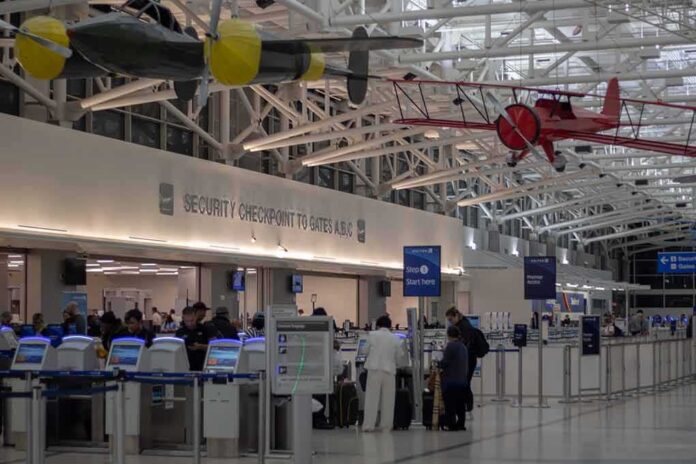
For 95 minutes on the year’s busiest travel week, Chicago’s main gateway paused inbound flights because there were not enough air traffic controllers on duty.
Story Snapshot
- The Federal Aviation Administration (FAA) paused flights bound for O’Hare due to staffing at Chicago approach control.
- The stop began at 10:40 a.m. Central Time and was expected to end at 12:15 p.m..
- Multiple outlets reported the same cause and timetable as the FAA’s notice.
- O’Hare departures faced rising delays as arrivals were held at origin airports.
What Exactly Happened And When
The Federal Aviation Administration said flights headed to Chicago O’Hare International Airport were paused late Monday morning because of staffing limits at Chicago Terminal Radar Approach Control, known as TRACON. The order started at 10:40 a.m. Central Time and was expected to run until 12:15 p.m., according to the Chicago Sun-Times. NBC Chicago, WGN, and NewsNation all reported the same staffing cause and the same planned end time as the FAA’s alert.
The hold targeted inbound flights to avoid stacking planes in the air space around Chicago. The move also slowed departures from O’Hare as gates and crews adjusted, with early estimates near 15 minutes and climbing, NBC Chicago reported. Shaw Local cited the Federal Aviation Administration’s operational alert at 10:40 a.m. and an 11:21 a.m. update that delays linked to staffing would continue to ripple. The approach facility handles sequencing and spacing for arrivals, so a shortfall there forces upstream fixes.
Why A Staffing Pause Hits So Hard
Approach control is the last handoff before the runway. When staffing dips below safe levels, managers lower the arrival rate, and sometimes they halt inbound flow. That keeps planes on the ground at their origin rather than holding in the sky. The Chicago TRACON manages a dense web of arrival paths, which means even small shortages can trigger ground stops to protect safety margins. The timing, at the start of Thanksgiving week, magnified each minute of delay.
Reporters did not have details on the exact number of controllers on position, who called in sick, or which sectors went dark. The Federal Aviation Administration did not publish rosters or thresholds. But the stated cause tracks with national data: the Government Accountability Office reported the controller workforce fell about six percent from 2015 to 2025, while traffic rose about ten percent. That mismatch leaves little slack on peak days. When a few people are out, the room for error vanishes.
How This Fits The Bigger Picture
Independent reviews have warned about thin staffing at key facilities. The National Academies pointed to past hiring gaps, a misaligned workforce, and weak scheduling as drivers of shortages across many sites. The Government Accountability Office urged the Federal Aviation Administration to set clearer hiring goals and track results, because holes at approach facilities can turn into real-world delays and cancellations. When you place Chicago’s pause in that frame, it looks less like a shock and more like the system acting on its limits.
Travelers feel those limits most during holiday surges. Planes leave fuller. Turn times shrink. Any pause stacks fast. Common sense says the fix is straightforward but not quick: train more controllers, align staffing with demand, and design schedules that match peak traffic. Conservative principles favor a competent core government function that works on time, every day. Air traffic control is that function. It should get the people and tools it needs, and it should show taxpayers clear results.
What We Know, What Matters Next
The facts are tight and consistent. The Federal Aviation Administration said staffing at Chicago approach control caused the inbound pause. The agency set a clear window. Major local outlets reported the same facts and timetable. O’Hare departures felt rising delays as arrivals were held. Specific headcounts were not released, which is common in real-time operations. That gap does not change the key point: fewer qualified controllers on position meant less arrival capacity, so the pause protected the safety buffer.
Airlines and airports will sort the tail of Monday’s delays by evening. The more important test is whether days like this become rarer next year. The Government Accountability Office numbers say the pipeline still lags demand, even with many applicants. The National Academies say smarter staffing targets and better shifts can add capacity without lowering safety. Chicago’s 95-minute pause sent a simple message to anyone stuck at the gate: when you short the tower, the country waits on the ground.
Sources:
facebook.com, chicago.suntimes.com, fox5atlanta.com, wabcradio.com, nbcchicago.com, gao.gov
© horizonpost.com 2026. All rights reserved.