

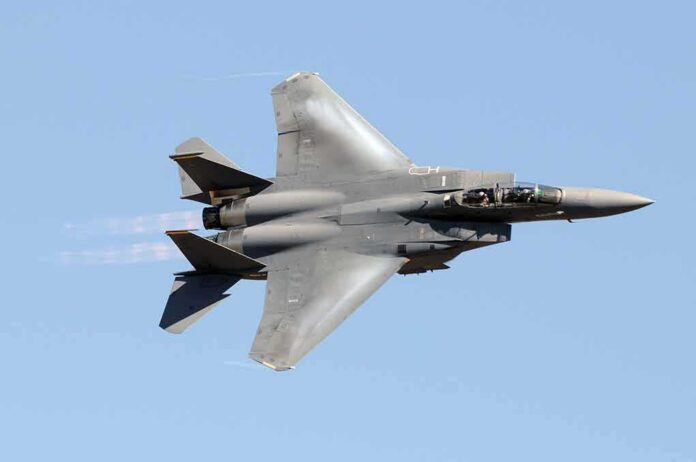
Two days alone in Iran’s mountains ended at sunrise when U.S. rescuers sprinted through gunfire and lifted “Bravo” to safety.
Story Snapshot
- A U.S. F-15E crew ejected over Iran after a missile strike; both survived.
- The pilot was rescued within hours; the weapons officer, “Bravo,” after about 50 hours.
- Newly declassified video shows elite Air Force rescuers grabbing Bravo and extracting him.
- Reporters call the rescue one of the largest, most complex in U.S. military history.
Shot Down Over Iran, Then Two Days Of Hiding And Hurt
CBS News reports that the two-seat F-15E Strike Eagle took a hit from an Iranian missile in April. The pilot and the weapons systems officer, an Air Force colonel known as “Dude 44 Bravo,” ejected. Both survived. Iranian forces hunted the crash sites. The pilot linked up with rescuers within hours. Bravo landed far from him, injured, and began working his training plan: move, hide, signal, and wait for the window that might save him.
Bravo’s first public account came on 60 Minutes. He described being blasted out of the jet, tumbling, and praying as he fell. He hit the ground hard, hurt but alive, and crawled to cover. He rationed water, checked his gear, and kept his locator dark when he heard vehicles and voices. He shifted positions at night, stayed cold, and watched the clock. He listened for rotors and jets that might mean help, or danger, or both.
Rescue At Sunrise: Elite Airmen Run Into Fire
Newly declassified footage shows the endgame. A helicopter drops to a rocky landing zone as two U.S. Air Force pararescuers sprint out. They grab Bravo, pull him aboard, and the aircraft lifts away. The video does not reveal routes or units, but it captures the moment the waiting stopped. The pararescuers did what they train to do: find the survivor, secure him, and leave fast before the enemy can mass on the site.
Officials and reporters describe the broader mission as massive. Assets spanned helicopters, fixed-wing cover, surveillance, and special operations teams coordinating across borders and time zones. The effort stretched for about two days, threading windows between enemy patrols and missile threats. The scale fits the stakes. America sends a clear message to every aircrew: if you go down, we come. That is not bravado. That is a promise paid in planning, risk, and skill.
Fifty Hours To Wheels-Up: Timeline And Choices
CBS reports the pilot went first, rescued within hours. Bravo held out much longer, evading at least two days until a dawn liftoff on Easter Sunday. That timeline matches the survival math. Move in daylight and you get spotted. Move at night and terrain slows you. Turn on your beacon too long and the enemy can home on it. Keep it off and friendlies cannot. He solved that puzzle minute by minute until a window finally opened.
🔴🇺🇸 🇮🇷 Inside the High Risk F-15E Rescue Mission In Iran
Newly declassified footage offers a rare look inside the U.S. operation to recover the Weapons Systems Officer of an F-15E Strike Eagle shot down over Iran on April 3, 2026.
The pilot was rescued shortly after the… pic.twitter.com/2lWEdfTTjM
— Defense Intelligence (@DI313_) September 14, 2026
The New York Times reported that U.S. commandos went deep into Iran for the extraction and all returned safely with the weapons officer. That detail underscores the reach and discipline behind the “no one left behind” creed. It also shows how much risk was accepted to keep faith with that promise. The team got in, found their man, and got out. That is the standard America should demand and fund, every time.
What This Rescue Says About Power, Values, And Foes
PBS NewsHour framed the operation as a daring rescue of two aviators from a fighter shot down by Iran. That simple line carries weight. Iran fired, an American jet fell, and the United States answered with a precise, dangerous recovery inside hostile territory. This is deterrence and duty working together. Adversaries learn we do not abandon our own. Aircrew learn that training and grit matter until the cavalry arrives—and it will.
Why The 60 Minutes Account Matters Now
The 60 Minutes interview puts a human face on a sprawling operation. Bravo’s voice closes the loop between the cockpit, the crash, the cold nights, and the roar of rotor wash at rescue. The details of routes and units stay classified, as they should during active threats. The core facts stand on the record: a missile strike, two ejections, a fast first rescue, a second at sunrise two days later, and every American home alive.
Sources:
© horizonpost.com 2026. All rights reserved.