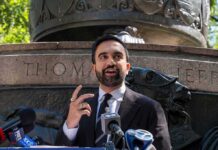

A deadly confrontation between federal immigration agents and Minneapolis residents forced President Trump to reconsider his deployment of 3,000 federal agents in Minnesota after Governor Tim Walz turned a local tragedy into a national showdown over state sovereignty.
Story Snapshot
- Border Patrol agent fatally shot 37-year-old Alex Pretti in south Minneapolis during Operation Metro Surge, the third shooting and second death since federal agents arrived
- Governor Walz demanded immediate withdrawal of agents, accusing Trump’s operation of causing fear, violence and chaos in one of America’s safest states
- After a Monday phone call, Trump agreed to consider reducing agent numbers and allowing Minnesota Bureau of Criminal Apprehension to lead investigations
- Trump dispatched Border Czar Tom Homan to Minneapolis to coordinate a shift toward targeting violent criminals rather than broad immigration enforcement
When Federal Force Meets Local Fury
Operation Metro Surge deployed approximately 3,000 ICE and Border Patrol agents to Minneapolis as part of Trump’s expanded interior immigration enforcement. The operation began roughly a month before the fatal shooting, immediately sparking mass protests despite sub-zero wind chills. Tens of thousands of Minnesotans took to the streets, creating an unusual coalition that transcended typical political divisions. The operation’s timing and scope suggested federal targeting of perceived sanctuary jurisdictions, yet Minnesota’s Department of Corrections maintains perfect compliance with ICE detainers, undermining claims that state cooperation was lacking.
Alex Pretti’s death on Saturday morning on Eat Street became the flashpoint. A Border Patrol agent shot the 37-year-old during enforcement activities in a diverse south Minneapolis neighborhood, marking the third shooting by federal agents since their arrival. A VA nurse had already been killed in an earlier incident. The Department of Homeland Security blocked Minnesota Bureau of Criminal Apprehension investigators from the Pretti shooting scene despite state warrants, a move that inflamed tensions between federal and state authorities. This obstruction became central to Walz’s Sunday afternoon press conference where he accused federal agents of operating as an untrained occupying force.
The Governor’s Gambit Pays Dividends
Walz positioned his Sunday demand as both moral imperative and political calculation. He appealed directly to Trump to show decency and pull agents from Minnesota, framing the operation as a catastrophic failure that united rather than intimidated Minnesotans. His office highlighted that Minnesota ranks among the nation’s safest states under existing law enforcement, questioning the rationale for federal intervention. The governor invoked Pretti’s family and the VA nurse’s death as symbols of federal overreach harming innocent residents who simply wanted to live without interference. His rhetoric painted a picture of disciplined state resistance against chaotic federal force.
The Monday morning phone call between Trump and Walz produced surprising concessions. Trump’s Truth Social post characterized the conversation as productive, claiming both leaders operated on a similar wavelength regarding targeting violent criminals. The President asserted crime was way down, though he provided no data supporting this claim amid reports of multiple federal agent shootings. Walz’s office confirmed Trump agreed to three key concessions: consulting with DHS on BCA access to crime scenes, considering reduction of agent numbers, and coordinating more effectively to focus exclusively on violent criminals rather than broad immigration sweeps.
Border Czar Homan Enters the Equation
Trump’s deployment of Tom Homan to Minneapolis signals a tactical shift in federal immigration enforcement strategy. Homan’s role involves managing the operation on the ground and implementing the new framework agreed upon during the Trump-Walz call. This move represents acknowledgment that Operation Metro Surge’s execution created political and operational problems requiring recalibration. The appointment suggests Trump recognized the Minnesota situation differed from reported successes in Washington D.C., Memphis, and New Orleans, where federal operations apparently proceeded without comparable community backlash or fatal incidents involving agents.
The concessions raise questions about operational oversight and training. If federal agents require state coordination to focus on violent criminals rather than conducting broad enforcement, it suggests mission creep or inadequate operational parameters from the start. Minnesota’s Department of Corrections honors every ICE detainer without release failures, demonstrating state cooperation on legitimate criminal targets. The violence accompanying Operation Metro Surge, particularly shootings by federal agents, contradicts Trump’s crime reduction claims and supports Walz’s characterization of the operation as counterproductive. State law enforcement being sidelined despite proven competence undermines arguments for federal necessity.
Sovereignty Questions Without Clear Answers
The Minnesota confrontation establishes precedent for federal-state immigration enforcement negotiations. Walz leveraged public sympathy from fatalities and massive protests to extract meaningful concessions from a president generally resistant to scaling back enforcement operations. Whether Trump follows through on reducing agent numbers and permitting state-led investigations remains uncertain. No confirmed withdrawals have occurred, and DHS action on BCA access stays pending. The agreement’s vague language about considering reductions provides Trump flexibility to claim cooperation while maintaining substantial federal presence.
Minneapolis immigrant communities experienced tangible fear during the operation, with reports of children hiding and families disrupting normal routines to avoid federal agents. The social impact extends beyond enforcement targets to entire neighborhoods living under heightened anxiety. Politically, the situation energizes Walz’s narrative about federal overreach while potentially pressuring Trump among voters who value local control and question excessive federal authority. The operation’s trajectory may influence how other Democratic governors respond to similar federal deployments, potentially creating a template for resistance that balances law enforcement cooperation with protection of state investigatory authority and community trust.
Sources:
CBS Minnesota: Walz demands Trump remove federal agents after fatal Minneapolis shooting
FOX 9: President Trump, Gov. Walz have productive call over ICE operations
Politico Playbook: Trump makes a shift in Minnesota