

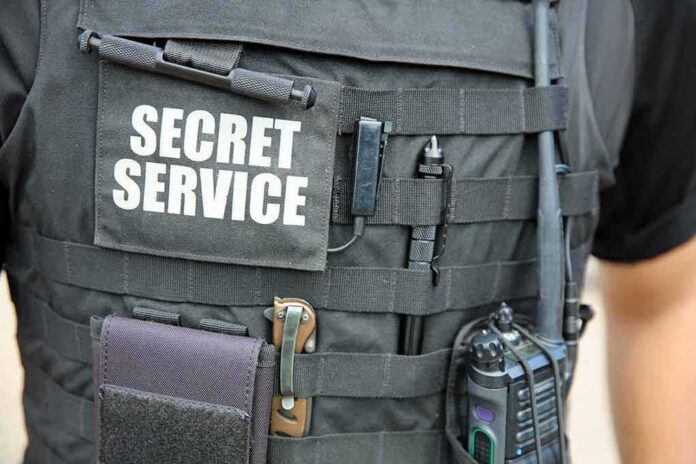
Three senior Secret Service communications officials were escorted out, stripped of clearances, and benched as investigators dig into a suspected leak tied to presidential security.
Story Snapshot
- Three Secret Service communications staff, including chief Anthony Guglielmi, placed on leave.
- Security clearances revoked and “do not admit” designations reported at headquarters.
- Federal Bureau of Investigation (FBI) and Central Intelligence Agency (CIA) reportedly engaged in the probe.
- Case overlaps with Trump’s secret Turkey-to-Britain plane swap during an Iran-linked threat.
What Happened Inside Secret Service Headquarters
Secret Service officials removed three communications-office employees from their posts and put them on administrative leave. Outlets named Chief of Communications Anthony Guglielmi among them, citing U.S. officials and internal actions such as revoked clearances and “do not admit” status at headquarters. The agency confirmed three non-law-enforcement personnel were placed on leave for potential misconduct. The Office of Professional Responsibility is running the review, which can refer matters for criminal inquiry if warranted.
Multiple reports said the FBI and CIA are participating, a signal this reaches beyond a routine personnel dust-up. That kind of interagency footprint usually follows concerns about the handling of sensitive national-security information. The Secret Service has not released chargeable specifics. The public posture remains an administrative review. That caveat aside, the facts on the ground—escorts, clearances, lockdowns—show the agency is treating the matter as serious.
The Sensitive Backdrop: A Secret Presidential Plane Swap
The suspected leak traces to a high-stakes episode earlier this month. The Washington Post reported that an Iranian-linked threat to assassinate President Trump drove a covert move: Air Force One acted as a decoy while Trump quietly boarded a different military jet in Turkey and flew to Britain. Trump later said the Secret Service and the military wanted him on “a different plane” because of the threat, confirming the switch and the security concern that triggered it.
Major outlets detailed the cloak-and-dagger choreography, including a catering-truck cover to mask the move off the decoy aircraft. Reports described some senior officials remaining aboard the decoy plane to preserve the ruse. Even as intelligence agencies assessed parts of the Iran threat with low confidence, the Secret Service maintained tight protective steps. That split highlights why mishandling any related operational details would be treated as a grave breach.
Why This Probe Looks Bigger Than Office Drama
Clearance pulls and escorted removals inside security services are not rare during sensitive inquiries. But the reported involvement of the FBI and the CIA, plus the link to live presidential-protection operations, takes this episode into a different lane. The Secret Service statement’s restrained wording—“potential misconduct” and an internal review—matches common practice. Agencies often start administratively while preserving paths to a criminal case if facts demand it.
Recent history backs that pattern. The Pentagon’s 2025 leak inquiry placed multiple officials on leave as the probe widened, underscoring that removal during an investigation is standard, not a verdict. The Secret Service also has dealt with internal disclosure failures before, including the 2015 case in which dozens faced discipline over an improper data access related to a member of Congress. These precedents argue for swift containment first, with findings to follow.
The Stakes: Protecting a President Beats Feeding the Rumor Mill
Operational leaks about a president’s movements can put a target on his back and strain allies who help keep him safe. During an Iran-linked scare, revealing flight changes, decoys, or timing gives bad actors a playbook. Common sense—and conservative instincts about order and duty—say you lock that down, fast. If investigators confirm an unauthorized disclosure, strong penalties fit the risk. If not, due process clears names and restores trust without apology for the caution taken.
Drain the swamp!!!
Three Secret Service Officials — Including Communications Chief — Escorted Out and Stripped of Security Clearances Amid Reported Criminal Leak Probe — FBI and CIA Reportedly Involved https://t.co/LTJBarWGwv #gatewaypundit via @gatewaypundit
— JimGilles (@brojim3) August 26, 2026
The public will want names, motives, and receipts. That may take time. Classification rules limit what can be shared while operations continue. The clean path forward is clear: let the Office of Professional Responsibility finish, let the FBI and CIA do their work if involved, and publish as much as can be safely released. When you guard a president in a hostile world, secrecy is not theater; it is survival. This case shows the system still knows when to slam the vault.
Sources:
thegatewaypundit.com, yahoo.com, washingtonpost.com, newsbreak.com, democracynow.org, thehill.com, bbc.com, cnn.com, aa.com.tr, oig.dhs.gov
© horizonpost.com 2026. All rights reserved.